
- 54lessons
- 5guided projects
- 9module checkpoints
- 0.8hours of video
What you'll learn
- Create, configure, run and diagnose an ASP.NET Core 10 Web API locally and explain the host, configuration sources and middleware pipeline.
- Design routes, binding and typed responses that satisfy a written HTTP contract and verify them against a generated OpenAPI document.
- Validate input in two layers and return one structured error format that never leaks internals.
- Structure application services with the built-in dependency injection container, choosing lifetimes, test seams, validated options and cancellation.
- Persist data with EF Core and SQLite, using relationships, migrations, projections, stable paging, transactions and optimistic concurrency, and prove persistence across restarts.
Skills you'll gain
- Hosting
- configuration
- Endpoints
- routing
- Models
- validation
- Dependency injection
- Data access
- Authentication
- authorization
- Integration tests
- Service operations
- API project
Tools you'll use
- C#
- ASP.NET Core
- EF Core
- SQLite
- xUnit
- dotnet CLI
Details to know
- Certificate on completionIssued after your final project is reviewed
- 9 module checkpointsA quiz and a practical task close each module
- Self-pacedStudy any time; your progress is saved
How every lesson works
Each lesson follows the same four steps, so you always know what comes next.
- 01
Watch & Learn
A short animated video explains one idea at a time.
- 02
Guided Practice
Work through an example step by step and check the result.
- 03
Quiz & Challenge
Short questions check the idea has landed before you move on.
- 04
Mini Project
Build something useful from a project brief.
Learn at your own pace
This is a self-paced course. There are no live classes and no fixed timetable.
- Start any timeStudy when it suits you. Lessons are short, so they fit around work or college.
- Pick up where you left offYour progress is saved to your account.
- Ask when you're stuckUse Ask Mentor inside the learning platform.
Your path in 6 phases
Each phase ends with something you have built and checked.
- 01
Modules 1 to 2
ScopeTime workspace, contract and first endpoints
Covers Hosting and configuration and Endpoints and routing.
You build: Guided project: ScopeTime.sln with API and test projects, SETUP.md, TRACE.md, three-zone Program.cs, layered configuration, pipeline gate and /ping with DIAGNOSE.md.
- 02
Module 3
Validated booking input with one error format
Covers Models and validation.
You build: Guided project: Request, response and entity types, a JSON edge-case table and two-layer validation.
- 03
Modules 4 to 5
Services and persistence
Covers Dependency injection and Data access.
You build: Guided project: BookingService, container registrations, fakes, validated options and cancellable search.
- 04
Module 6
Secured ScopeTime
Covers Authentication and authorization.
You build: Guided project: Deny-by-default pipeline, validated bearer tokens and named policies.
- 05
Modules 7 to 8
Tested and operable ScopeTime
Covers Integration tests and Service operations.
You build: Guided project: Factory-based integration suite with personas, isolation and a regression test.
- 06
Module 9
Final project and assessment
Covers API project, then the final project: ASP.NET Core API with tested authorization and data access.
You build: Final project, one of: Tool library API / Allotment plot API / Repair cafe appointment API.
Full curriculum
9 modules and 54 lessons, 26 to 45 hours of study
01Hosting and configuration6 lessons, 3 to 4 hours
Lessons
- How a web API handles requests
- Create an ASP.NET Core workspace
- Application startup and hosting
- Configuration and environments
- The middleware pipeline
- First endpoint and local diagnostics
After this module you can
- Trace an HTTP request from a client through an application to a response.
- Identify the SDK, project files and local development entry point.
- Run a bounded local endpoint and distinguish startup errors from HTTP failures.
02Endpoints and routing6 lessons, 3 to 4 hours
Lessons
- HTTP methods and route contracts
- Minimal API route handlers
- Route, query and body binding
- Typed responses and failure paths
- Controllers and action routing
- OpenAPI and endpoint documentation
After this module you can
- Choose methods and response statuses that match a resource operation.
- Map a handler and distinguish route patterns from handler logic.
- Document a bounded API contract and check it against actual responses.
03Models and validation6 lessons, 3 to 4 hours
Lessons
- Request and response DTOs
- JSON and nullable values
- Validation boundaries
- Problem details responses
- Consistent update contracts
- Validation test matrix
After this module you can
- Separate public contracts from stored entities and internal implementation.
- Distinguish absent, null and malformed values during deserialization.
- Design independent valid, missing and malformed input cases for a resource.
04Dependency injection6 lessons, 3 to 4 hours
Lessons
- Services and responsibilities
- Register and resolve dependencies
- Singleton, scoped and transient
- Interfaces and substitutes
- Options and configuration validation
- Cancellation and asynchronous work
After this module you can
- Separate endpoint orchestration from a testable application service.
- Use explicit service registration and constructor or handler injection.
- Propagate cancellation through a bounded asynchronous operation.
05Data access6 lessons, 3 to 4 hours
Lessons
- Entity Framework Core and DbContext
- Model relationships and constraints
- Migrations in an isolated database
- Queries, projections and pagination
- Transactions and concurrency
- Persistence and restart evidence
After this module you can
- Explain tracked entities, database context lifetime and persistence boundaries.
- Model a bounded resource relationship with required integrity rules.
- Verify stored resource state after reopening the application and database.
06Authentication and authorization6 lessons, 3 to 4 hours
Lessons
- Identity versus permission
- Token validation boundaries
- Claims and authorization policies
- Resource ownership checks
- Browser clients, CORS and HTTPS
- Unauthorized and forbidden cases
After this module you can
- Separate verifying a caller from granting an operation.
- Explain issuer, audience, signature and expiry checks without inventing a token service.
- Test missing identity, insufficient permission and allowed access separately.
07Integration tests6 lessons, 3 to 4 hours
Lessons
- Testing the HTTP contract
- WebApplicationFactory and the test host
- Controlled test dependencies
- Positive and negative request cases
- Authorization integration tests
- Isolation and regression coverage
After this module you can
- Separate service unit checks from an actual endpoint integration test.
- Create an isolated application host for repeatable requests.
- Reset synthetic fixtures and demonstrate independent repeatable test runs.
08Service operations6 lessons, 3 to 4 hours
Lessons
- Structured logs and request tracing
- Health and readiness endpoints
- Exceptions and safe failure responses
- Limits and resilience boundaries
- Build and configuration handoff
- Operational verification checklist
After this module you can
- Record useful request context without logging secrets or personal payloads.
- Distinguish process liveness from readiness to serve a required dependency.
- Verify startup, dependencies, failure behavior and rollback requirements in a local lab.
09API project6 lessons, 3 to 4 hours
Lessons
- Choose and specify a service
- Plan contracts and ownership
- Build a vertical feature
- Complete tests and failure handling
- Prepare reproducible submission
- Demonstrate the working API
After this module you can
- Define an approved resource API with measurable functional acceptance cases.
- Document endpoints, data relationships and who may perform each operation.
- Show permitted and rejected requests plus persistence in a trainer-reviewed walkthrough.
What you'll build
5 guided projects along the way, then a final project.
ScopeTime workspace, contract and first endpoints
after module 2Validated booking input with one error format
after module 3Services and persistence
after module 5Secured ScopeTime
after module 6Tested and operable ScopeTime
after module 8
Final project
ASP.NET Core API with tested authorization and data access. Options: Tool library API / Allotment plot API / Repair cafe appointment API.
What you submit
Source and artifact submission: a clean repository, a README with prerequisites, setup, run and test commands and a recorded SDK and package version list.
How it's reviewed
Trainer-reviewed demonstration, scored on: Contract fidelity and OpenAPI accuracy Validation and structured errors Authorization and ownership Data access, constraints and concurrency Automated tests and mutation evidence.
Where you'll use it
- Return one consistent validation error format across a booking API.
- Restrict a resource so members only see their own records, and prove it with an integration test.
Roles that use these skills
- .NET Developer
- Backend Developer
- API Developer
Earn the certificate by building, not watching
- Complete the lessons and pass each module checkpoint.
- Build your final project and demonstrate it.
- OUTLEARN reviews your project and issues your certificate. It is not issued automatically.
Frequently asked questions
What do I need before starting?
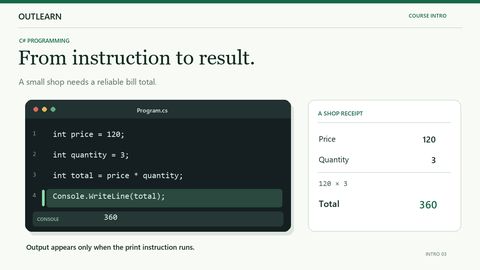
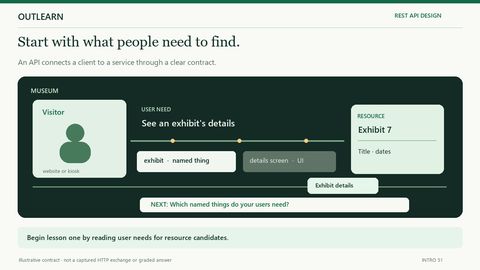
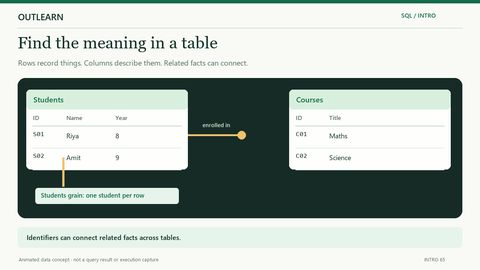
Prerequisite courses: C# Programming, REST API Design and SQL and Database Foundations, or accepted equivalents. You can write C# records, interfaces and async methods with a CancellationToken, use nullable reference types and write an xUnit test with a hand-made fake; read an HTTP request and response and say which status and headers fit a resource operation; and write a join between two tables with a foreign key and explain what a transaction guarantees.
When do I get a certificate?
We do not issue certificates until you successfully build and demonstrate your live project. Staff issue certificates after review; nothing is issued automatically.
Be first in when ASP.NET Core Web APIs opens
Email us and we will tell you as soon as enrolment opens.
Notify me when it opens