
- 48lessons
- 4guided projects
- 8module checkpoints
- 2.0hours of video
What you'll learn
- Draw a data-flow diagram, run STRIDE and rank abuse cases for a service
- Validate input at the edge, prevent mass assignment and fail safely
- Enforce deny-by-default, object-level and tenant-scoped authorization and test it with a matrix
- Prevent SQL, command, path and SSRF-class injection with parameterisation, allow-lists and fixed destinations
- Bound body size, result size, time and request rate and resist business-logic abuse
Skills you'll gain
- API trust boundaries
- Authorization
- tenancy
- Injection defences
- Request limits
- Secrets
- tokens
- Dependency
- transport controls
- Audit logging
- Security verification
Tools you'll use
- Node.js
- Express
Details to know
- Certificate on completionIssued after your final project is reviewed
- 8 module checkpointsA quiz and a practical task close each module
- Self-pacedStudy any time; your progress is saved
How every lesson works
Each lesson follows the same four steps, so you always know what comes next.
- 01
Watch & Learn
A short animated video explains one idea at a time.
- 02
Guided Practice
Work through an example step by step and check the result.
- 03
Quiz & Challenge
Short questions check the idea has landed before you move on.
- 04
Mini Project
Build something useful from a project brief.
Learn at your own pace
This is a self-paced course. There are no live classes and no fixed timetable.
- Start any timeStudy when it suits you. Lessons are short, so they fit around work or college.
- Pick up where you left offYour progress is saved to your account.
- Ask when you're stuckUse Ask Mentor inside the learning platform.
Your path in 4 phases
Each phase ends with something you have built and checked.
- 01
Modules 1 to 2
Threat model and authorization core for Shelfshare
Covers API trust boundaries and Authorization and tenancy.
You build: Guided project: dfd.md, threats.csv and abuse-cases.md; Edge validation, safe errors, policy registry, owner and tenant scoping and the authorization matrix.
- 02
Modules 3 to 4
Injection and abuse resistance
Covers Injection defences and Request limits.
You build: Guided project: Parameterised queries, allow-listed identifiers, safe file and outbound access, content-type hygiene.
- 03
Modules 5 to 6
Secrets, supply chain and transport hardening
Covers Secrets and tokens and Dependency and transport controls.
You build: Guided project: Scan gate, environment configuration, rotation runbook, restricted roles, cookie assertions, hashed keys.
- 04
Modules 7 to 8
Final project and assessment
Covers Audit logging and Security verification, then the final project: Hardened local API with threat model and abuse-case tests.
You build: Final project, one of: Harden the Shelfshare library-lending API supplied by the course (multi-tenant, roles, cover import, CSV export) / Harden a second supplied planted-vulnerability API.
Full curriculum
8 modules and 48 lessons, 29 to 50 hours of study
01API trust boundaries6 lessons, 3 to 4 hours
Lessons
- Draw a data-flow diagram with trust boundaries
- Enumerate threats per boundary with STRIDE
- Turn threats into ranked abuse cases
- Validate input at the edge with an allow-list schema
- Reject unknown fields and stop mass assignment
- Fail safely with generic errors and one central handler
After this module you can
- Produce a data-flow diagram of the Shelfshare API that names every external entity, process, data store and the trust boundary each request crosses.
- Apply the six STRIDE categories to each boundary crossing in a diagram and record one concrete threat, the affected property and a proposed control.
- Install one global error handler that returns a generic JSON body with a request id while logging details server-side, and verify no stack trace reaches the client.
02Authorization and tenancy6 lessons, 3 to 5 hours
Lessons
- Deny by default and tell 401 from 403
- Check object ownership on every request (IDOR)
- Scope every query by tenant
- Enforce role and function-level permissions
- Existence leaks and why unpredictable ids are not authorization
- Build a role-by-endpoint authorization test matrix
After this module you can
- Add authorization middleware that rejects any route without an explicit policy and returns 401 for missing or invalid credentials and 403 for authenticated callers who lack permission.
- Fix an insecure direct object reference by verifying that the authenticated caller may access the specific record, not just the record type.
- Generate a test matrix of roles, tenants and endpoints with an expected outcome for every cell and run it against a vulnerable and a fixed build.
03Injection defences6 lessons, 3 to 5 hours
Lessons
- Parameterise values so data never becomes SQL
- Allow-list dynamic identifiers such as sort columns
- Avoid shell commands and block path traversal
- Handle ORM raw-query escape hatches and operator injection
- Block server-side request forgery in outbound fetches
- Return correct content types and neutralise stored data on output
After this module you can
- Replace string-built SQL in a handler with a parameterised query and show that an apostrophe in a value is stored and returned as plain data.
- Handle user-selected column names and sort directions by mapping them to a fixed set of known identifiers rather than inserting request text.
- Serve JSON with an accurate Content-Type and nosniff, and verify that stored markup-like text comes back as inert data; hand off browser rendering defences to the earlier course.
04Request limits6 lessons, 3 to 5 hours
Lessons
- Cap request body size and enforce Content-Type
- Cap page size and bound query cost
- Set timeouts on requests, upstream calls and statements
- Implement rate limiting and answer with 429
- Choose rate-limit keys and trust proxy headers correctly
- Limit business-logic abuse with quotas, idempotency and uniform responses
After this module you can
- Set a maximum body size that returns 413 and require a supported Content-Type on bodies, returning 415 otherwise.
- Give list endpoints a maximum page size, a default, and bounded filters so a single request cannot request an unbounded result set.
- Add per-account quotas and idempotency keys on state-changing routes and make account-existence checks return uniform responses to resist scripted enumeration.
05Secrets and tokens6 lessons, 3 to 5 hours
Lessons
- Find hardcoded secrets with a scanner
- Load secrets from the environment and fail fast
- Respond to a leaked secret: revoke, rotate, then clean
- Give each credential least privilege and separate environments
- Verify cookie and token hygiene without redefining authentication
- Generate, store and compare tokens and API keys safely
After this module you can
- Run a secret scanner over a working tree and its git history, read the report and classify each finding as real, test fixture or false positive.
- Move secrets from source into runtime configuration, validate their presence at startup and keep them out of version control and logs.
- Generate API keys with a cryptographically secure random source, store only a hash of each key, and compare secrets without leaking information through early exits.
06Dependency and transport controls6 lessons, 3 to 5 hours
Lessons
- Reproducible installs with lockfiles
- Audit dependencies and triage advisories
- Review new dependencies before adding them
- Protect data in transit with TLS and strong certificate checks
- Send security headers and assert them
- Harden configuration defaults and CORS
After this module you can
- Commit a lockfile and install from it with a command that fails when the manifest and lockfile disagree.
- Run a dependency audit, set a failure threshold, and write a triage decision for each finding using OWASP's case approach.
- Create a production configuration baseline that disables debug features, removes default credentials and restricts cross-origin access to an explicit origin list, with a test that fails on drift.
07Audit logging6 lessons, 3 to 5 hours
Lessons
- Decide which security events to log
- Write structured logs with correlation ids
- Keep secrets and personal data out of logs
- Neutralise log injection
- Turn logs into detection signals and alerts
- Protect log integrity, retention and logging failures
After this module you can
- Write an event catalogue naming the security events Shelfshare must record, the fields each needs and the events that must never be silently dropped.
- Emit one JSON log line per security event containing a request id propagated from the entry point, and show two lines from one request joining on that id.
- Restrict log access, add tamper evidence with a hash chain, define retention, and ensure a logging failure never takes the API down or leaks data.
08Security verification6 lessons, 3 to 4 hours
Lessons
- Write an abuse-case test from a threat row
- Compare vulnerable and fixed builds to prove each control
- Gate merges with secret scans and dependency audits
- Build a header and response assertion pack
- Map requirements to tests with ASVS and the OWASP Top 10
- Report findings and run a pre-release security review
After this module you can
- Translate one threat-register row into an executable test with an arrange step, an attack-shaped request using harmless values, and an assertion on the safe outcome.
- Run one suite against two builds and produce a table of expected red/green outcomes that proves each fix is what makes a test pass.
- Write findings with severity, evidence and retest status, and run a pre-release checklist over the hardened API with a go or no-go decision.
What you'll build
4 guided projects along the way, then a final project.
Threat model and authorization core for Shelfshare
after module 2Injection and abuse resistance
after module 4Secrets, supply chain and transport hardening
after module 6Audit logging and verification pack
after module 8
Final project
Hardened local API with threat model and abuse-case tests.
What you submit
Source repository with vulnerable and fixed builds and setup instructions that run on loopback only Threat model (DFD, STRIDE register, ranked abuse cases) and traceability table to a chosen subset of ASVS.
How it's reviewed
Trainer-reviewed demonstration, scored on: Coverage of the top-ranked abuse cases (30%) Evidence quality: red then green results (25%) Correctness of authorization, injection and limits controls (20%) Secrets, logging and configuration hygiene (15%).
Where you'll use it
- Add tenant checks so one customer can never read another customer's records.
- Add rate limits and audit logs to a sensitive endpoint and test both.
Roles that use these skills
- Backend Developer
- Application Security Engineer
- DevSecOps Engineer
Earn the certificate by building, not watching
- Complete the lessons and pass each module checkpoint.
- Build your final project and demonstrate it.
- OUTLEARN reviews your project and issues your certificate. It is not issued automatically.
Related courses
Take first
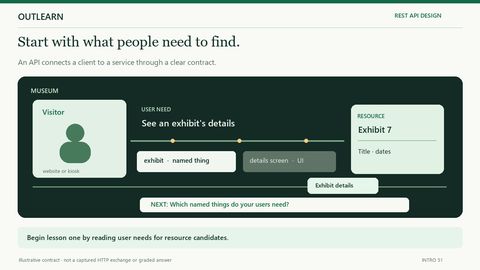 FreeWeb apps & analytics
REST API Design
50 lessons, 27 to 47 hours
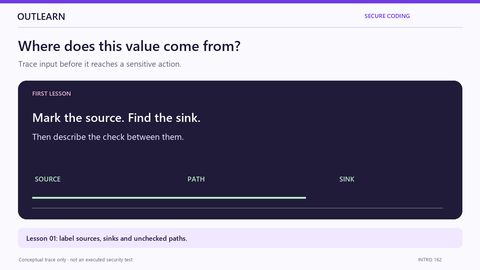 FreeWeb apps & analytics
Secure Coding Fundamentals
54 lessons, 30 to 54 hours
This course is part of the Backend Developer bundle: 3 courses for ₹499, against ₹597 bought one by one.
Frequently asked questions
What do I need before starting?
Comfortable building and running a small REST API with a database (REST API Design, the earlier course or the earlier course server framework basics, the earlier course or equivalent SQL familiarity) and the command line. Diagnostic: from memory, add a validated POST route and a test that reads a record back; a learner who cannot is directed to the earlier course first.
When do I get a certificate?
We do not issue certificates until you successfully build and demonstrate your live project. Staff issue certificates after review; nothing is issued automatically.
Be first in when Backend Security Fundamentals opens
Email us and we will tell you as soon as enrolment opens.
Notify me when it opens