
- 53lessons
- 4guided projects
- 8module checkpoints
- 1.1hours of video
What you'll learn
- Model a relational schema in Prisma, generate a typed client and construct it with a driver adapter
- Express one-to-many, one-to-one, many-to-many and self relations with deliberate constraints and referential actions
- Query, filter, paginate and aggregate with the client and predict result types
- Create, review, edit, baseline and deploy migrations and seed repeatably across environments
- Keep multi-step writes consistent with nested writes, interactive transactions, optimistic concurrency, retries and idempotency
Skills you'll gain
- Schema
- client generation
- Relations
- constraints
- Queries
- includes
- Migrations
- environments
- Transactions
- Query performance
- Testing
- cleanup
- ORM integration
Tools you'll use
- TypeScript
- Node.js
- Prisma ORM
- Express
Details to know
- Certificate on completionIssued after your final project is reviewed
- 8 module checkpointsA quiz and a practical task close each module
- Self-pacedStudy any time; your progress is saved
How every lesson works
Each lesson follows the same four steps, so you always know what comes next.
- 01
Watch & Learn
A short animated video explains one idea at a time.
- 02
Guided Practice
Work through an example step by step and check the result.
- 03
Quiz & Challenge
Short questions check the idea has landed before you move on.
- 04
Mini Project
Build something useful from a project brief.
Learn at your own pace
This is a self-paced course. There are no live classes and no fixed timetable.
- Start any timeStudy when it suits you. Lessons are short, so they fit around work or college.
- Pick up where you left offYour progress is saved to your account.
- Ask when you're stuckUse Ask Mentor inside the learning platform.
Your path in 4 phases
Each phase ends with something you have built and checked.
- 01
Modules 1 to 2
Maker-space equipment ledger: schema and typed client
Covers Schema and client generation and Relations and constraints.
You build: Guided project: Pinned project, validated schema, generated client in a chosen folder, adapter-backed client module.
- 02
Modules 3 to 4
Equipment ledger: queries and migration history
Covers Queries and includes and Migrations and environments.
You build: Guided project: Typed query functions with hand-computed expected results on a seed.
- 03
Modules 5 to 6
Equipment ledger: transactional checkout and performance report
Covers Transactions and Query performance.
You build: Guided project: Checkout function using an interactive transaction, version check and idempotency key, with failure-case counts.
- 04
Modules 7 to 8
Final project and assessment
Covers Testing and cleanup and ORM integration, then the final project: Database-backed service with reviewed migrations and transactional tests.
You build: Final project, one of: Equipment-loan service for a maker space: members, tools, loans with return dates, overdue report, transactional checkout and return.
Full curriculum
8 modules and 53 lessons, 30 to 50 hours of study
01Schema and client generation6 lessons, 3 to 4 hours
Lessons
- Pinning the Prisma 7 toolchain and prisma.config.ts
- Declaring models and scalar fields in schema.prisma
- Generating the client with the prisma-client generator and output path
- Constructing PrismaClient with the SQLite driver adapter
- Reading generated types: inputs, payloads and satisfies
- Mapping names with @map and @@map and managing timestamps
After this module you can
- Create a project whose package.json pins prisma and @prisma/client to major 7 and whose prisma.config.ts points at a SQLite file through env().
- Write a schema.prisma with two models using @id, @default, optional fields and @unique, and predict the column types and nullability Prisma will use.
- Rename a model and fields in the database with @@map and @map while keeping the TypeScript names, and add createdAt and updatedAt columns that fill themselves.
02Relations and constraints6 lessons, 3 to 4 hours
Lessons
- One-to-many relations with @relation and a foreign key scalar
- One-to-one and optional relations with a unique foreign key
- Many-to-many with implicit join tables and explicit join models
- Unique constraints, composite uniques and @@index
- Referential actions: onDelete and onUpdate
- Self-relations and multiple relations between the same models
After this module you can
- Model an author with many books using a relation field, a foreign key scalar and @relation(fields, references), and read the FOREIGN KEY clause in the migration SQL.
- Create a one-to-one profile relation by making the foreign key @unique, and distinguish required from optional sides.
- Model a hierarchy with a self-relation and disambiguate two relations between the same pair of models using relation names.
03Queries and includes8 lessons, 3 to 5 hours
Lessons
- Creating rows with create, createMany and nested create
- Reading with findUnique, findFirst, findMany and the OrThrow variants
- Filtering with where operators and logical combinators
- Choosing fields with select and loading relations with include
- Filtering by related rows with some, every, none, is and isNot
- Updating and deleting: update, updateMany, upsert, delete and atomic operations
- Sorting and paginating with orderBy, skip, take and cursor
- Counting and grouping with count, aggregate and groupBy
After this module you can
- Insert one row, many rows and a parent with children in one call, and state what each method returns.
- Select the correct finder for a lookup, predict null versus thrown errors and handle P2025.
- Use count, aggregate and groupBy to answer summary questions in the database instead of in JavaScript.
04Migrations and environments7 lessons, 3 to 5 hours
Lessons
- Creating the first migration with prisma migrate dev
- Evolving a schema: adding a required column with create-only and a backfill
- Reviewing migration SQL: renames, drops and destructive changes
- Applying and checking migrations: deploy, reset, status, db push and drift
- Configuring environments with prisma.config.ts and environment variables
- Baselining an existing database with migrate diff and migrate resolve
- Seeding repeatably with db seed and idempotent upserts
After this module you can
- Run migrate dev on a new schema and identify the migration folder, the SQL file and the _prisma_migrations bookkeeping table it produced.
- Use migrate dev --create-only, edit the SQL to backfill existing rows and apply it without data loss.
- Configure migrations.seed in prisma.config.ts, run prisma db seed explicitly and write a seed that is safe to run repeatedly.
05Transactions6 lessons, 3 to 4 hours
Lessons
- Atomicity from nested writes and the failure that proves it
- Batch transactions with $transaction and an array of operations
- Interactive transactions: tx client, rollback by throwing, timeouts
- Lost updates and optimistic concurrency with a version column
- Isolation levels, serialization failures and a retry wrapper for P2034
- Idempotent writes: unique keys, upsert and handling P2002 on retries
After this module you can
- Explain why a single nested write is already a transaction and demonstrate rollback with a deliberately failing child.
- Group independent operations in one $transaction array call and predict ordering, results and rollback.
- Make a write safe to repeat by using a client-supplied unique key and treating P2002 as already done.
06Query performance7 lessons, 3 to 5 hours
Lessons
- Logging queries and counting statements to see the N+1 pattern
- Removing N+1 with include, in-lists and relationLoadStrategy
- Trimming payloads with select and omitting heavy columns
- Raw queries with $queryRaw and $executeRaw and avoiding injection
- Indexes and EXPLAIN QUERY PLAN: proving an index is used
- Pagination performance on large tables: offset cost versus cursor
- Connection lifecycle and pooling: one client, adapter pools, P2024
After this module you can
- Enable query logging, count statements per operation and recognise a loop that issues one query per row.
- Replace a per-row lookup with one relation load or one in-filter query and verify the statement count dropped.
- Create exactly one client per process, configure the adapter pool deliberately and explain P2024 pool timeouts.
07Testing and cleanup6 lessons, 3 to 4 hours
Lessons
- Isolating a test database and guarding against running on dev data
- Preparing the test schema: applying migrations before the suite
- Resetting state between tests: ordered deletes, truncation and rollback
- Deterministic fixtures and factories for test data
- Testing error paths: P2002, P2003 and P2025 as assertions
- Unit tests with an injected client versus integration tests, and testing transactions
After this module you can
- Point tests at a dedicated SQLite file and add a guard that refuses to run when the URL is not a test database.
- Build the test database from committed migrations with migrate deploy in a global setup step and verify the resulting tables match the schema.
- Decide which logic needs a real database and which can use a stub behind an interface, and test a transaction's rollback.
08ORM integration7 lessons, 3 to 5 hours
Lessons
- A repository layer that returns plain data, not Prisma types
- Mapping database errors to HTTP responses in Express
- Client lifecycle in a running service: one instance, shutdown and hot reload
- Designing list endpoints: pagination contract and bounded includes
- Client extensions with $extends: computed fields and shared query behaviour
- Build and release path: generate in build, migrate deploy in release
- Release review: migration checklist, transactional tests and version re-check
After this module you can
- Wrap Prisma calls in repository functions that accept and return plain domain types, so routes never import the generated client.
- Translate known request error codes into 404, 409 and 400 responses with a single error-handling middleware.
- Run a final release review of the service: a migration checklist, a green transactional test suite and a recorded decision on Prisma 7 versus the ORM 8 release.
What you'll build
4 guided projects along the way, then a final project.
Maker-space equipment ledger: schema and typed client
after module 2Equipment ledger: queries and migration history
after module 4Equipment ledger: transactional checkout and performance report
after module 6Equipment ledger: tested HTTP service
after module 8
Final project
Database-backed service with reviewed migrations and transactional tests. Options: Equipment-loan service for a maker space: members, tools, loans with return dates, overdue report, transactional checkout and return.
What you submit
Source and artifact submission: repository with schema, committed migrations, seed, service code and tests, pinned to the Prisma ORM 7 line.
How it's reviewed
Trainer-reviewed demonstration, scored on: Schema and constraints enforce the rules in the database, not only in code Migrations are reviewed: no unexplained destructive statements and a backfill where needed.
Where you'll use it
- Ship a reviewed schema migration across development and production environments.
- Wrap a checkout in a transaction so stock and loans always agree.
Roles that use these skills
- Backend Developer
- Full-Stack Developer
- Node.js Developer
Earn the certificate by building, not watching
- Complete the lessons and pass each module checkpoint.
- Build your final project and demonstrate it.
- OUTLEARN reviews your project and issues your certificate. It is not issued automatically.
Frequently asked questions
What do I need before starting?
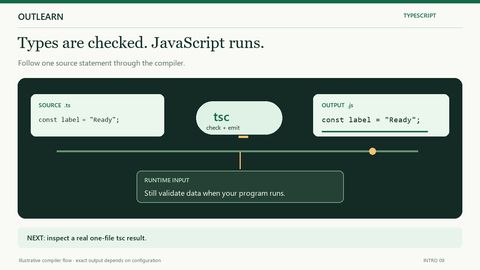
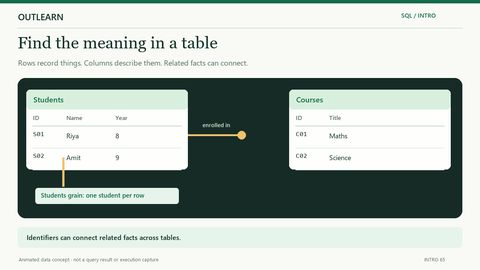
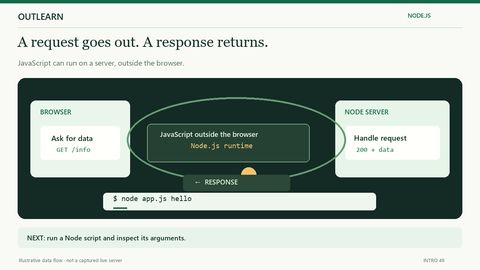
Comfortable TypeScript (types, async/await, modules), SQL basics (tables, keys, joins, transactions) and a working Node.js project with an HTTP route. Alternatives to the listed courses are accepted when a short diagnostic is passed: write a typed async function, a two-table JOIN and an Express route returning JSON.
When do I get a certificate?
We do not issue certificates until you successfully build and demonstrate your live project. Staff issue certificates after review; nothing is issued automatically.
Be first in when Prisma ORM opens
Email us and we will tell you as soon as enrolment opens.
Notify me when it opens