
- 48lessons
- 3guided projects
- 8module checkpoints
- 1.0hours of video
What you'll learn
- Estimate, measure and honestly report what a cache saves (latency and origin load) and what it costs (staleness, memory, extra failure modes).
- Design key names, value encodings and expiry policy so cached entries are findable, versioned and bounded in time.
- Implement cache-aside reads including negative caching, TTL jitter and single-flight protection against stampedes.
- Invalidate cached data on writes, reason about read/write races that resurrect stale values, and test staleness bounds.
- Use Redis single-command atomicity, SET NX, MULTI/EXEC with WATCH, and Lua scripts to remove check-then-act races.
Skills you'll gain
- Cache purpose
- costs
- Keys types
- expiry
- Cache-aside behavior
- Invalidation
- consistency
- Atomic operations
- Rate limiting boundaries
- Failure
- fallback
- Cache integration project
Tools you'll use
- Redis Open Source
- redis-cli
- Docker
- Python
- redis-py
- pytest
- sqlite3
Details to know
- Certificate on completionIssued after your final project is reviewed
- 8 module checkpointsA quiz and a practical task close each module
- Self-pacedStudy any time; your progress is saved
How every lesson works
Each lesson follows the same four steps, so you always know what comes next.
- 01
Watch & Learn
A short animated video explains one idea at a time.
- 02
Guided Practice
Work through an example step by step and check the result.
- 03
Quiz & Challenge
Short questions check the idea has landed before you move on.
- 04
Mini Project
Build something useful from a project brief.
Learn at your own pace
This is a self-paced course. There are no live classes and no fixed timetable.
- Start any timeStudy when it suits you. Lessons are short, so they fit around work or college.
- Pick up where you left offYour progress is saved to your account.
- Ask when you're stuckUse Ask Mentor inside the learning platform.
Your path in 4 phases
Each phase ends with something you have built and checked.
- 01
Modules 1 to 2
Cache economics and key design workbook
Covers Cache purpose and costs and Keys types and expiry.
You build: Guided project: Loopback-only lab setup note with version and licence statement, latency model, hit-ratio probe, staleness register, memory-pressure test and cold/warm benchmark.
- 02
Modules 3 to 4
Cache-aside read path with invalidation tests
Covers Cache-aside behavior and Invalidation and consistency.
You build: Guided project: Cache-aside read layer with negative caching, canonical list keys, jittered TTLs, single-flight loader and a written write-strategy decision.
- 03
Modules 5 to 6
Atomic guards and rate limiters
Covers Atomic operations and Rate limiting boundaries.
You build: Guided project: Race demonstrations and fixes: INCR sequence numbers, SET NX idempotency guard, MULTI/EXEC transcripts, WATCH and Lua reservations under 20 threads, fenced lock.
- 04
Modules 7 to 8
Final project and assessment
Covers Failure and fallback and Cache integration project, then the final project: Cache-enabled service with measured correctness and invalidation tests.
You build: Final project, one of: Equipment-loan desk service: catalogue reads, loan creation with idempotency and per-user limiting / Event-listing service: listings, ticket-count reads, booking with idempotency and per-IP limiting / Timetable-and-alerts service: route reads.
Full curriculum
8 modules and 48 lessons, 27 to 45 hours of study
01Cache purpose and costs6 lessons, 3 to 4 hours
Lessons
- Starting a throwaway Redis and reading its version and licence
- Expected latency as a function of hit ratio
- Measuring hit ratio from INFO keyspace counters
- Staleness budgets and what is safe to cache
- Memory limits and eviction policy choice
- Benchmarking a cache without fooling yourself
After this module you can
- Start a local Redis container bound to 127.0.0.1, confirm it answers PING, read redis_version from INFO server, and state which licence options apply to Redis 8 and to 7.4.
- Compute mean request latency from hit time, origin time and hit ratio, and solve for the hit ratio needed to meet a latency target.
- Run a skewed read workload against an origin with and without a cache and report cold-start, warm p50 and p95 latency together with the measured hit ratio.
02Keys types and expiry7 lessons, 3 to 5 hours
Lessons
- Namespaced, versioned key names and SCAN instead of KEYS
- Strings as serialized cache values with a schema version
- Hashes for cached records read and updated by field
- Sorted sets for cached top-N lists and atomic snapshot swaps
- TTL values, -1 and -2, and what overwrites an expiry
- EXPIRE conditions NX, XX, GT and LT and sliding expiry
- How Redis really removes expired keys
After this module you can
- Design a key scheme app:version:entity:id, explain why a value-format change bumps the version segment, and count keys in one namespace using a SCAN loop with MATCH and COUNT.
- Store a record as a JSON string with an embedded schema version, read many entries with MGET preserving order and nil for misses, and treat unreadable or old-version payloads as cache misses.
- Explain passive and active expiry, why a key may linger in memory past its TTL while being unreadable, and why expiry deadlines are absolute timestamps.
03Cache-aside behavior6 lessons, 3 to 4 hours
Lessons
- The cache-aside read path step by step
- Negative caching of not-found results
- Cache keys for parameterised queries
- TTL jitter to avoid synchronised expiry
- Stampede protection with a single-flight lock
- Choosing write strategies: cache-aside, write-through, write-around and write-behind
After this module you can
- Implement get_item(id) that checks Redis first, loads from the origin on a miss, writes the result with a TTL, and returns the same value on both paths.
- Cache a not-found answer with a short TTL using a sentinel the codec can distinguish from a real value, and show repeated requests for a missing id stop reaching the origin.
- Compare four write strategies by the failure each introduces and pick one for a described workload, justifying the choice with the staleness budget and failure behaviour.
04Invalidation and consistency6 lessons, 3 to 4 hours
Lessons
- Delete on write instead of updating the cached copy
- The read/write race that resurrects stale data
- Generation counters for invalidating a group of keys
- Tracking dependent keys with index sets
- Propagating invalidation to other processes with Pub/Sub and tracking
- Testing the staleness bound with a stale-read detector
After this module you can
- Implement an update path that commits the origin change first and then deletes the cache key, and explain why deleting is safer than writing a recomputed value into the cache.
- Reproduce, with a deterministic interleaving, how a slow reader can write an old value into the cache after a writer deleted it, and apply a mitigation that bounds the damage.
- Write a test harness that stamps values with versions, runs reads and writes concurrently, and reports the maximum observed staleness and any read older than the allowed bound.
05Atomic operations6 lessons, 3 to 4 hours
Lessons
- Single-command atomicity and the lost-update race
- SET with NX for create-if-absent and idempotency keys
- MULTI and EXEC: what a transaction guarantees and what it does not
- WATCH and optimistic locking with a retry loop
- Lua scripts for compare-and-act in one step
- Lock limits: leases, expiry during work, and fencing tokens
After this module you can
- Show that GET then SET loses updates under concurrency while INCR does not, and explain why a single Redis command is not interleaved with another client's command.
- Use SET key value NX EX to claim an operation exactly once, interpret OK versus nil, and make a retried request return the original result instead of repeating the effect.
- Explain when a SET NX PX lock fails to give mutual exclusion, and design a fencing check that rejects a write from a holder whose lease expired.
06Rate limiting boundaries6 lessons, 3 to 4 hours
Lessons
- Fixed-window counter with INCR and EXPIRE
- The window-edge burst problem
- Atomic window setup: avoiding a counter that never expires
- Sliding-window log with a sorted set
- Token bucket with server-side time
- Limiter keys, 429 responses and Retry-After
After this module you can
- Implement allow(client, limit, window_seconds) with a per-window key, INCR and an expiry, and return allowed or denied together with the remaining count.
- Show with injected time that a fixed-window limiter admits up to twice its limit in a short interval straddling a window boundary, and compute that worst case.
- Choose the identity a limiter counts (user, API key, IP, route), return HTTP 429 with a Retry-After header derived from the limiter, and avoid trusting a spoofable client address.
07Failure and fallback6 lessons, 3 to 4 hours
Lessons
- Timeouts: treating Redis errors as cache misses
- Circuit breaker and origin protection when Redis fails
- Restarts, empty caches and warm-up
- Memory pressure: noeviction errors and eviction side effects
- Observability: the numbers that tell you a cache is healthy
- Fail-open or fail-closed: choosing per feature
After this module you can
- Configure connect and read timeouts on the client, catch connection and timeout errors around cache calls, and fall back to the origin so the request still succeeds within a time bound.
- Stop calling an unhealthy Redis after repeated failures, probe it periodically, and cap concurrent origin calls so a Redis outage does not turn into an origin outage.
- Decide and test the behaviour of a rate limiter, an idempotency guard, a cache read and a lock when Redis is unavailable, and justify each as fail-open or fail-closed.
08Cache integration project5 lessons, 2 to 4 hours
Lessons
- Project contract, data model and baseline measurement
- Cache-aside reads with measured hit behaviour
- Invalidation on writes with a stale-read test
- Rate limits and failure behaviour wired into the service
- Evidence pack, runbook and trainer-reviewed demonstration
After this module you can
- Write the service contract (endpoints, status codes, staleness budgets, targets) and measure the uncached baseline latency and origin load before any cache code exists.
- Add cache-aside reads, negative caching, canonical list keys, jittered TTLs and single-flight to the read endpoints, with tests that count origin calls.
- Assemble the measured evidence (before and after numbers, staleness table, failure matrix), write a short runbook, and prepare a scripted demonstration that a trainer can run from a clean checkout.
What you'll build
3 guided projects along the way, then a final project.
Cache economics and key design workbook
after module 2Cache-aside read path with invalidation tests
after module 4Atomic guards and rate limiters
after module 6
Final project
Cache-enabled service with measured correctness and invalidation tests.
What you submit
Source submission: complete code for a small HTTP service backed by a SQL database (sqlite3 is acceptable) plus Redis, with tests, in a repository the trainer can clone.
How it's reviewed
Trainer-reviewed demonstration, scored on: Measured benefit: Baseline and cached results under the same seed with honest limitations Correctness under change: Invalidation tests and detector results, mutations caught.
Where you'll use it
- Cache a slow catalogue read and invalidate it when the item changes.
- Limit requests per user and keep the service working when Redis is down.
Roles that use these skills
- Backend Developer
- Software Engineer
- Site Reliability Engineer
Earn the certificate by building, not watching
- Complete the lessons and pass each module checkpoint.
- Build your final project and demonstrate it.
- OUTLEARN reviews your project and issues your certificate. It is not issued automatically.
Frequently asked questions
What do I need before starting?
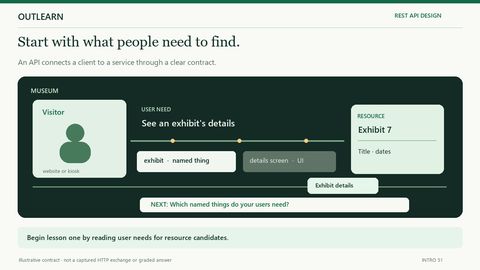
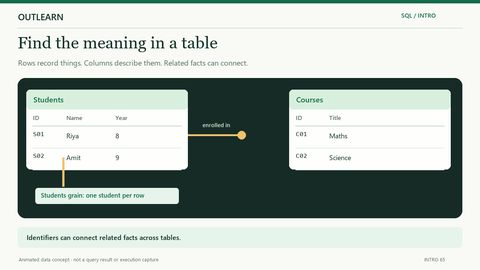
Prerequisite courses: REST API Design (HTTP verbs, status codes, resource representations) and SQL and Database Foundations (reading and writing rows through SQL, transactions, persistence). Diagnostic check before module 1: (1) given a GET /items/7 endpoint, state which status code a missing item returns and which header could carry a retry delay; (2) write a SELECT that fetches one row by primary key and say what an index on that column changes.
When do I get a certificate?
We do not issue certificates until you successfully build and demonstrate your live project. Staff issue certificates after review; nothing is issued automatically.
Be first in when Redis & Caching opens
Email us and we will tell you as soon as enrolment opens.
Notify me when it opens