
- 58lessons
- 3guided projects
- 9module checkpoints
- 1.2hours of video
What you'll learn
- Convert a business question into a metric definition and state the grain of every table used.
- Aggregate at the correct grain with filters, FILTER/CASE conditional aggregation, ratios and ROLLUP/GROUPING SETS.
- Predict join cardinality, detect fan-out, and repair double counting by pre-aggregation or semi-joins.
- Structure analysis as tested CTE pipelines and prove refactors equal with EXCEPT.
- Use window functions for ranking, deduplication, running totals, moving averages, period comparison and shares, choosing frames deliberately.
Skills you'll gain
- Analysis questions
- data grain
- Filtering
- aggregation
- Joins
- double counting
- CTEs
- subqueries
- Window functions
- Dates
- cohorts
- Funnels
- sessions
- event sequences
Tools you'll use
- SQL
- DuckDB
Details to know
- Certificate on completionIssued after your final project is reviewed
- 9 module checkpointsA quiz and a practical task close each module
- Self-pacedStudy any time; your progress is saved
How every lesson works
Each lesson follows the same four steps, so you always know what comes next.
- 01
Watch & Learn
A short animated video explains one idea at a time.
- 02
Guided Practice
Work through an example step by step and check the result.
- 03
Quiz & Challenge
Short questions check the idea has landed before you move on.
- 04
Mini Project
Build something useful from a project brief.
Learn at your own pace
This is a self-paced course. There are no live classes and no fixed timetable.
- Start any timeStudy when it suits you. Lessons are short, so they fit around work or college.
- Pick up where you left offYour progress is saved to your account.
- Ask when you're stuckUse Ask Mentor inside the learning platform.
Your path in 4 phases
Each phase ends with something you have built and checked.
- 01
Modules 1 to 3
Tidewater grain and aggregation brief
Covers Analysis questions and data grain, Filtering and aggregation and Joins and double counting.
You build: Guided project: Metric definition card, grain statements with uniqueness queries, row-count profile and a FILTER-based monthly status table.
- 02
Modules 4 to 6
Customer value and cohort retention study
Covers CTEs and subqueries, Window functions and Dates and cohorts.
You build: Guided project: CTE pipeline with assertions, deduplicated customers and window-based top-N and running series.
- 03
Modules 7 to 8
Funnel and validation dossier
Covers Funnels, sessions and event sequences and Query validation.
You build: Guided project: Ordered, time-bounded and channel-segmented funnel with sessions.
- 04
Module 9
Final project and assessment
Covers Analysis report, then the final project: Reproducible business analysis notebook with SQL queries and interpretation.
You build: Final project, one of: Retention and repeat-purchase analysis of the Tidewater kit with cohort matrix, time to second order and recommendations framed as hypotheses / Conversion funnel and session analysis of the events table, segmented by channel.
Full curriculum
9 modules and 58 lessons, 31 to 52 hours of study
01Analysis questions and data grain6 lessons, 3 to 4 hours
Lessons
- Turning a business question into a metric definition
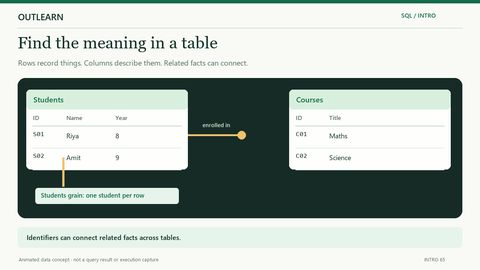
- Declaring the grain of a table
- Reading a schema as a map of keys and relationships
- Setting up the DuckDB lab and loading the seeded kit
- Profiling a table before analysing it
- Mapping analytics features across DuckDB, PostgreSQL and SQLite
After this module you can
- Rewrite a vague request as a metric with a numerator, denominator, population, time window and exclusions.
- State in one sentence what one row of a table represents and name the column set that identifies it uniquely.
- Build a one-page dialect table for window functions, FILTER, GROUPING SETS, QUALIFY, IGNORE NULLS and division, citing the official docs for each cell.
02Filtering and aggregation7 lessons, 3 to 5 hours
Lessons
- Half-open date ranges for period filters
- NULL-aware predicates and three-valued logic
- COUNT variants and distinct counting
- GROUP BY at the declared grain; HAVING versus WHERE
- Conditional aggregation with FILTER and CASE
- Ratios, averages and the average-of-averages trap
- Subtotals with ROLLUP, CUBE and GROUPING SETS
After this module you can
- Filter a timestamp column to a calendar period using an inclusive start and exclusive end so no boundary row is lost or counted twice.
- Predict which rows survive a WHERE clause when a column contains NULL and write predicates that handle NULL on purpose.
- Produce a report with detail, subtotal and grand-total rows in one query and tell generated NULLs from data NULLs with GROUPING.
03Joins and double counting6 lessons, 3 to 4 hours
Lessons
- Predicting join row counts from cardinality
- Fan-out: how a one-to-many join inflates a sum
- Pre-aggregating before joining to restore the grain
- LEFT JOIN, ON versus WHERE, and anti-joins
- Semi-joins with EXISTS and the NOT IN NULL trap
- Reconciling a joined result to a control total
After this module you can
- Predict the row count of an inner join from the two tables' grains and verify the prediction with a count query.
- Show with numbers that summing a parent-level measure after a one-to-many join counts it once per child row.
- Write a reconciliation query that compares a joined total with an independently computed control total and returns a pass or fail row.
04CTEs and subqueries6 lessons, 3 to 4 hours
Lessons
- Naming steps with common table expressions
- Scalar and correlated subqueries
- Building a CTE pipeline with a grain comment per step
- UNION ALL, UNION and EXCEPT for combining and comparing results
- Assertion queries after every CTE step
- Refactoring a tangled query and proving equivalence
After this module you can
- Rewrite a nested query as a WITH query whose named steps each do one job.
- Use a scalar subquery for a single benchmark value and a correlated subquery for a per-row comparison, and know when each is wrong.
- Refactor a deeply nested query into a CTE pipeline and prove the result unchanged by an EXCEPT check and a row-count check.
05Window functions9 lessons, 4 to 6 hours
Lessons
- OVER and PARTITION BY: aggregates that keep every row
- Ranking functions: ROW_NUMBER, RANK and DENSE_RANK with ties
- Top N per group with QUALIFY and the subquery form
- Deduplicating a feed by keeping the latest row per key
- Running totals and frame clauses: ROWS versus RANGE
- Moving averages over a fixed window
- LAG and LEAD for period-over-period change
- Percent of total and cumulative share
- NTILE, FIRST_VALUE and the default-frame trap
After this module you can
- Add a group-level aggregate beside each detail row with OVER (PARTITION BY ...) and explain how it differs from GROUP BY.
- Choose among ROW_NUMBER, RANK and DENSE_RANK for a stated ranking question and predict their values when ORDER BY values tie.
- Bucket rows into quantile groups with NTILE and read first and last values of a partition without the default-frame error.
06Dates and cohorts7 lessons, 3 to 5 hours
Lessons
- Truncating timestamps and the limits of time zones
- Calendar spines and gap filling
- Month-over-month and year-over-year comparison
- Defining a cohort by a first event
- Cohort age: months since the first event
- Retention matrix with correct denominators
- Repeat purchase rate and time to second order
After this module you can
- Bucket timestamps into day, week and month using date_trunc and state what the column's time zone assumption is.
- Generate a gap-free sequence of dates and left join measures to it so missing days appear as explicit zeros.
- Compute the share of customers with a second completed order and the days from first to second order with a numbered-orders CTE.
07Funnels, sessions and event sequences5 lessons, 2 to 3 hours
Lessons
- Funnel step counts with distinct users
- Ordered funnels: events in the right sequence
- Time-bounded conversion
- Sessionization with gap rules
- Segmenting a funnel without breaking denominators
After this module you can
- Count distinct users reaching each funnel step and compute step-to-step and overall conversion.
- Require that a user's step timestamps occur in order, so a later step counts only after the earlier one happened.
- Break the funnel down by channel or region using the segment's own first-step count as the denominator.
08Query validation7 lessons, 3 to 5 hours
Lessons
- Control totals and cross-table reconciliation
- Data-quality assertions: duplicates, orphans and null rates
- Impossible values, outliers and boundary dates
- Reading a DuckDB EXPLAIN plan
- Reducing work in analytical queries
- Verifying that two queries agree
- A re-runnable validation suite
After this module you can
- Reconcile a metric across two independent sources and explain a non-zero difference.
- Write assertion queries for duplicate keys, orphaned foreign keys and unexpected NULL rates that return the offending rows.
- Package assertions into one script that runs in a fresh database and returns a summary of passed and failed checks with a non-zero exit code on failure.
09Analysis report5 lessons, 2 to 3 hours
Lessons
- Framing the question, definitions and data lineage
- A single-script reproducible pipeline
- Interpreting results: denominators, effect size and context
- Limitations, assumptions and the validation appendix
- Peer review, handover and the final notebook
After this module you can
- Write the report's opening section: the question, metric definitions, grain of every table used and where each table came from.
- Organise the analysis into one script that rebuilds every result from raw tables on a fresh database.
- Review a colleague's analysis with a checklist, fix review findings, and deliver the notebook with run instructions.
What you'll build
3 guided projects along the way, then a final project.
Tidewater grain and aggregation brief
after module 3Customer value and cohort retention study
after module 6Funnel and validation dossier
after module 8
Final project
Reproducible business analysis notebook with SQL queries and interpretation.
What you submit
Source/artifact submission: the notebook or script, the loader seed and the output files in a repository Functional checks: stated row counts and totals reproduce from a fresh database, validation suite passes on clean data and fails on faulty data.
How it's reviewed
Trainer-reviewed demonstration, scored on: definitions and grain: Metrics and table grains stated and used consistently correctness: Results reconcile to control totals and pass the suite.
Try the first lesson
Analysis questions and data grain
An operations team wants to count orders by region. The input has one row per order item, so an order can appear several times.
Your turn. Decide what one row should represent in your result. Compare the line-item count with the distinct order count.
SELECT region, COUNT(DISTINCT order_id) AS orders
FROM order_items
GROUP BY region;
Where you'll use it
- Product teams measure where users drop out of a signup funnel.
- Operations teams compare order volumes and delays by location and week.
Roles that use these skills
- Data Analyst
- Reporting Analyst
- Business Analyst
Earn the certificate by building, not watching
- Complete the lessons and pass each module checkpoint.
- Build your final project and demonstrate it.
- OUTLEARN reviews your project and issues your certificate. It is not issued automatically.
Frequently asked questions
What do I need before starting?
Prerequisite course SQL and Database Foundations, or equivalent: you can write SELECT with WHERE, ORDER BY, GROUP BY and HAVING, INNER and LEFT JOINs, understand primary and foreign keys, and have run SQL files against a local database. Diagnostic: without notes, write a query returning the number of orders per customer including customers with none, and explain why the count column must not use count(*).
When do I get a certificate?
We do not issue certificates until you successfully build and demonstrate your live project. Staff issue certificates after review; nothing is issued automatically.
Be first in when SQL for Analytics opens
Email us and we will tell you as soon as enrolment opens.
Notify me when it opens