
- 41lessons
- 4guided projects
- 8module checkpoints
- 0.9hours of video
What you'll learn
- Turn a vague brief into numbered, testable functional and non-functional requirements with SLIs and SLOs.
- Estimate load and storage with every assumption named, and recompute when one changes.
- Define service interfaces, data models and sequence diagrams that fit stated access patterns.
- Decompose latency, reason about percentiles, queues and bottlenecks, and verify with seeded simulations.
- Choose storage, caching and queueing designs by access pattern and failure behaviour, with written trade-offs.
Skills you'll gain
- Requirements
- workload
- Interfaces
- data
- Latency
- throughput
- Storage choices
- Caching
- queues
- Reliability
- failure
- Security
- observability
- Design trade-offs
Tools you'll use
- Python (standard library)
- Text-based diagrams
Details to know
- Certificate on completionIssued after your final project is reviewed
- 8 module checkpointsA quiz and a practical task close each module
- Self-pacedStudy any time; your progress is saved
How every lesson works
Each lesson follows the same four steps, so you always know what comes next.
- 01
Watch & Learn
A short animated video explains one idea at a time.
- 02
Guided Practice
Work through an example step by step and check the result.
- 03
Quiz & Challenge
Short questions check the idea has landed before you move on.
- 04
Mini Project
Build something useful from a project brief.
Learn at your own pace
This is a self-paced course. There are no live classes and no fixed timetable.
- Start any timeStudy when it suits you. Lessons are short, so they fit around work or college.
- Pick up where you left offYour progress is saved to your account.
- Ask when you're stuckUse Ask Mentor inside the learning platform.
Your path in 5 phases
Each phase ends with something you have built and checked.
- 01
Modules 1 to 2
Requirements, capacity and interface sheet for a booking service
Covers Requirements and workload and Interfaces and data.
You build: Guided project: Module 1 (Requirements and workload) artifacts added to the requirements, capacity and interface sheet for a booking service.
- 02
Modules 3 to 4
Latency budget and storage decision pack
Covers Latency and throughput and Storage choices.
You build: Guided project: Module 3 (Latency and throughput) artifacts added to the latency budget and storage decision pack.
- 03
Modules 5 to 6
Resilient read and write path
Covers Caching and queues and Reliability and failure.
You build: Guided project: Module 5 (Caching and queues) artifacts added to the resilient read and write path.
- 04
Module 7
Secure and observable design
Covers Security and observability.
You build: Guided project: Module 7 (Security and observability) artifacts added to the secure and observable design.
- 05
Module 8
Final project and assessment
Covers Design trade-offs, then the final project: System design dossier and small validated prototype.
You build: Final project, one of: URL shortener and redirect service dossier / Notification delivery service dossier / Event ticket reservation service dossier.
Full curriculum
8 modules and 41 lessons, 26 to 44 hours of study
01Requirements and workload6 lessons, 3 to 4 hours
Lessons
- Turning a brief into testable functional requirements
- Non-functional requirements as measurable quality attributes
- Scope boundaries, non-goals and the assumptions log
- Characterising workload: read/write mix, peak and payload size
- Back-of-envelope capacity estimation with stated assumptions
- SLIs, SLOs and error budgets as requirements
After this module you can
- Rewrite a vague product brief as at least six functional requirements, each phrased as actor, action and observable result with one pass/fail test.
- Express at least five non-functional requirements (performance, availability, durability, security, cost) as statements with a number, a unit and a measurement condition.
- Choose two service level indicators for a request path, set percentile-based SLO targets, and compute the monthly error budget in allowed bad requests and in minutes.
02Interfaces and data5 lessons, 2 to 4 hours
Lessons
- Context and container diagrams with trust and ownership boundaries
- Operation contracts: idempotency and safe retries
- Access patterns first: deriving entities and keys from queries
- Schema and contract evolution without breaking consumers
- Synchronous calls versus asynchronous messages at a boundary
After this module you can
- Draw a context diagram and a container diagram for a service, labelling each arrow with data carried and protocol, and mark which team or party owns each box.
- Specify three API operations with method, request and response shape, error cases and an explicit statement of whether a repeated identical request is safe, using an idempotency key where it is not.
- Draw sequence diagrams for the same step done synchronously and asynchronously and state what the caller knows, what can fail and what the user sees in each.
03Latency and throughput5 lessons, 2 to 4 hours
Lessons
- Latency budgets: splitting an end-to-end target across hops
- Percentiles, tail latency and why averages hide slow users
- Throughput, concurrency and Little's law
- Queueing and saturation: why latency explodes near full utilisation
- Finding the first bottleneck and what scaling can and cannot buy
After this module you can
- Break a 300 ms end-to-end target into per-hop allowances along a request path and mark which hops are controllable, which are fixed and where the remaining slack is.
- Generate a seeded skewed latency sample in Python, compute mean, p50, p95 and p99 with a stated percentile method, and explain what each shows about user experience.
- Compute the capacity of each tier in requests per second, name the first to saturate, and predict the speed-up from adding workers using Amdahl's law with a stated serial fraction.
04Storage choices5 lessons, 2 to 4 hours
Lessons
- Choosing a store family from access patterns and guarantees
- Indexes and read cost: scan versus index search with sqlite3
- Partitioning, shard keys and hot keys
- Replication, replica lag and read-your-writes
- Capacity over time: growth, retention and tiering
After this module you can
- Fill a decision matrix mapping four data sets to a store family (relational, key-value, document, object, search index) with the access pattern and guarantee each choice relies on.
- Use Python's sqlite3 module to create a table, run EXPLAIN QUERY PLAN before and after adding an index and report the plan change, query time and index cost on writes.
- Build a three-year storage projection with growth rate, replication factor and a retention rule, and show how moving cold data to a cheaper tier changes the totals without quoting any price.
05Caching and queues5 lessons, 2 to 4 hours
Lessons
- Cache-aside and the arithmetic of hit ratio
- TTL, invalidation and freshness as a staleness budget
- Cache failure modes: stampede, penetration and cold start
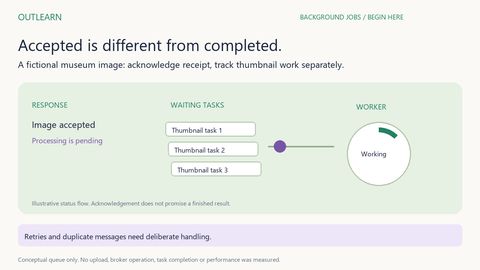
- Queues for decoupling: bounded buffers and backpressure
- Delivery semantics, idempotent consumers and dead-letter queues
After this module you can
- Compute effective read latency for a cache-aside design from hit ratio, cache time and database time, and find the hit ratio needed to meet a latency target.
- State the maximum staleness a TTL permits, choose between TTL expiry, explicit invalidation on write and write-through, and map the choice to HTTP freshness terms.
- Implement an at-least-once consumer that records processed message ids, test it by injecting duplicates and failures, and route repeatedly failing messages to a dead-letter list.
06Reliability and failure5 lessons, 2 to 4 hours
Lessons
- Availability arithmetic: series, parallel and the independence caveat
- Failure-mode analysis of a diagram and single points of failure
- Timeouts, retries, exponential backoff and jitter
- Circuit breakers, load shedding and graceful degradation
- Backups, RPO, RTO and rehearsed recovery
After this module you can
- Compute composite availability for components in series and in redundant parallel, convert to downtime per month, and state when the independence assumption makes the number optimistic.
- Walk every component and arrow of a container diagram, list how each can fail, the symptom a user or operator sees, how it is detected and the mitigation, and highlight single points of failure.
- Set recovery point and recovery time objectives from requirements, choose a backup and restore design that meets them, and write a rehearsal checklist with pass criteria.
07Security and observability5 lessons, 2 to 4 hours
Lessons
- Trust boundaries, abuse cases and threat enumeration
- Authentication versus authorisation and where each is enforced
- Data classification, encryption in transit and at rest, and secrets
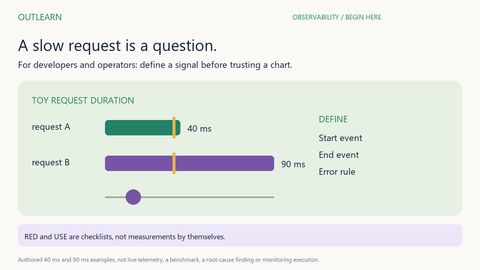
- Telemetry plan: logs, metrics and traces tied to the four golden signals
- SLO alerting: burn rates, thresholds and the first action
After this module you can
- Mark trust boundaries on a container diagram and list at least eight abuse cases, each with the attacker goal, the boundary crossed, an existing or proposed control and the residual risk.
- State for three endpoints and one service-to-service call who is authenticated, how, which authorisation rule applies, and where in the architecture each check is enforced.
- Compute burn rates and the time to exhaust the error budget for a given error rate and write alert rules that name a window, a threshold and the first action for the responder.
08Design trade-offs5 lessons, 2 to 4 hours
Lessons
- Architecture decision records with weighted criteria
- Consistency, availability and latency under partition
- Cost and complexity as design constraints
- Designing for growth: re-estimating at ten times load and staging a migration
- Design review, counterexamples and validating a small prototype
After this module you can
- Write a decision record that states the context, at least three options, weighted criteria with scores, the chosen option, the rejected alternatives with reasons and a revisit trigger.
- Analyse two failure scenarios (a partition between two regions and a slow replica) for a booking feature, decide whether it favours consistent or available behaviour and state the user-visible consequence of each choice.
- Review a design by trying at least five counterexamples against it, record outcomes, and validate one critical claim with a small prototype and a repeatable test script.
What you'll build
4 guided projects along the way, then a final project.
Requirements, capacity and interface sheet for a booking service
after module 2Latency budget and storage decision pack
after module 4Resilient read and write path
after module 6Secure and observable design
after module 7
Final project
System design dossier and small validated prototype. Options: URL shortener and redirect service dossier / Notification delivery service dossier / Event ticket reservation service dossier.
What you submit
Source/artifact submission: dossier markdown, diagram sources with text equivalents, capacity script or sheet, and the prototype source in a version-controlled folder.
How it's reviewed
Trainer-reviewed demonstration, scored on: Requirements are testable and traced to design elements Every estimate lists assumptions and recomputes when one changes At least three decision records with options, criteria and rejected alternatives.
Where you'll use it
- Estimate storage and request load for a new service from stated assumptions.
- Write a decision record comparing two storage or queue options with their trade-offs.
Roles that use these skills
- Software Engineer
- Backend Developer
- Solutions Architect
Earn the certificate by building, not watching
- Complete the lessons and pass each module checkpoint.
- Build your final project and demonstrate it.
- OUTLEARN reviews your project and issues your certificate. It is not issued automatically.
Frequently asked questions
What do I need before starting?
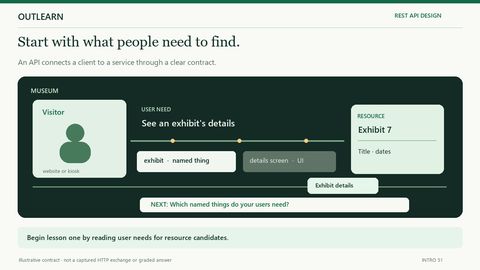
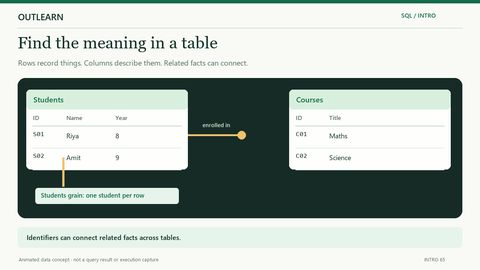
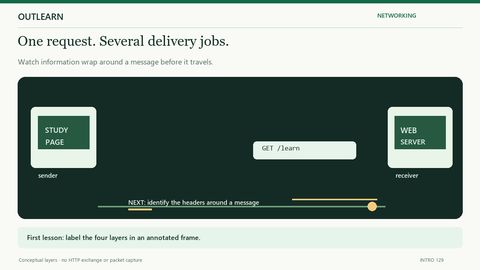
Comfortable reading and writing simple REST API contracts, basic SQL tables and queries and the basic network ideas of HTTP, DNS and TCP. Diagnostic check: you can explain what a GET versus a POST request means for repetition, write a SELECT with a join, and say what a DNS lookup does.
When do I get a certificate?
We do not issue certificates until you successfully build and demonstrate your live project. Staff issue certificates after review; nothing is issued automatically.
Be first in when System Design Fundamentals opens
Email us and we will tell you as soon as enrolment opens.
Notify me when it opens