
- 50lessons
- 6guided projects
- 8module checkpoints
- 2.0hours of video
What you'll learn
- Explain what an embedding is and is not, handle vectors and matrices in NumPy, and reason about geometry, concentration of distances and the limits of 2-D projections.
- Compute dot product, cosine and Euclidean scores, prove when they rank identically, interpret scores without treating them as probabilities, and return deterministic, diverse top-k results.
- Build a query path with BM25, hybrid fusion, metadata filtering, reranking, thresholds, empty-result handling and paging.
- Create judged query sets and measure search with precision, recall, hit rate, MRR, MAP and nDCG, compare systems with paired bootstrap intervals and classify failures by pipeline stage.
- Ship a versioned local search service with an index manifest, atomic swap, relevance regression gate, labelled fallback, privacy-aware logs and an evaluated demonstration.
Skills you'll gain
- Vector representations
- Embedding generation
- Similarity
- distance
- Index construction
- Retrieval queries
- Evaluation sets
- Costs
- privacy
- Search integration
Tools you'll use
- Python
- NumPy
- FAISS
- BM25
- pytest
Details to know
- Certificate on completionIssued after your final project is reviewed
- 8 module checkpointsA quiz and a practical task close each module
- Self-pacedStudy any time; your progress is saved
How every lesson works
Each lesson follows the same four steps, so you always know what comes next.
- 01
Watch & Learn
A short animated video explains one idea at a time.
- 02
Guided Practice
Work through an example step by step and check the result.
- 03
Quiz & Challenge
Short questions check the idea has landed before you move on.
- 04
Mini Project
Build something useful from a project brief.
Learn at your own pace
This is a self-paced course. There are no live classes and no fixed timetable.
- Start any timeStudy when it suits you. Lessons are short, so they fit around work or college.
- Pick up where you left offYour progress is saved to your account.
- Ask when you're stuckUse Ask Mentor inside the learning platform.
Your path in 3 phases
Each phase ends with something you have built and checked.
- 01
Modules 1 to 3
Vectors, embeddings and similarity
Handle vectors in NumPy, generate and chunk embeddings within token limits, and compare dot, cosine and Euclidean scores.
You build: Guided project: Vector table toolkit; Embedding pipeline with manifest and cache; Similarity engine with exact top-k.
- 02
Modules 4 to 6
Indexes, queries and evaluation
Build exact and approximate indexes with measured recall, add BM25 and hybrid ranking, and measure search with judged queries.
You build: Guided project: Indexes with measured recall; Hybrid search service core; Judged evaluation harness.
- 03
Modules 7 to 8
Cost, privacy and integration
Estimate cost, handle updates, deletes and personal data, and ship a versioned service with an atomic index swap and a regression gate.
You build: Guided project: Cost, lifecycle and privacy pack; Search service with gate, fallback and logs.
Full curriculum
8 modules and 50 lessons, 26 to 43 hours of study
01Vector representations6 lessons, 3 to 4 hours
Lessons
- What an embedding vector represents and what it does not
- Vectors and matrices in NumPy: shape, dtype and norm
- Angle, length and nearest neighbours in two dimensions
- Distance concentration: why high dimensions need measuring, not intuition
- Sparse count vectors versus dense embeddings: what each can match
- Projecting to two dimensions with PCA for inspection and what it distorts
After this module you can
- Given a supplied table of 12 item vectors, argue from nearest-neighbour lists which relationships the vectors encode and write three claims they do not support.
- Load a supplied .npz embedding table, validate shape and dtype, compute row norms and report which rows are zero, non-finite or mis-shaped.
- Reduce a supplied 32-dimensional table to 2-D with an SVD-based PCA, report explained variance and identify which neighbour relations in the plot are false.
02Embedding generation7 lessons, 3 to 5 hours
Lessons
- The encode contract: batching, order, dtype and a deterministic stub encoder
- Preparing text for embedding: normalisation and what to strip
- Chunk size and what one vector averages
- Token limits and silent truncation
- Queries and documents: asymmetric roles and model-card instructions
- Choosing and recording an embedding model: licence, dimension, size and language
- Caching embeddings with content hashes and a versioned table
After this module you can
- Wrap an encoder behind embed(texts) -> float32 array of shape (n, d) with preserved order and test the contract using a deterministic hash-based stub that needs no model download.
- Apply Unicode normalisation, whitespace cleanup and boilerplate removal to supplied raw strings and measure the effect on pairwise similarity of texts that differ only in markup.
- Build an embedding cache keyed by (model id, text hash) with a manifest and show that unchanged texts are not re-embedded and a model change invalidates the cache.
03Similarity and distance6 lessons, 3 to 4 hours
Lessons
- Dot product and vector length: what unnormalised scores reward
- Cosine similarity and unit normalisation
- Euclidean distance and its identity with cosine on unit vectors
- Choosing the metric to match the model, and why scores are not probabilities
- Top-k selection: ties, argpartition and batched matrix products
- Diversity and near-duplicates in results: maximal marginal relevance
After this module you can
- Compute dot-product scores for supplied vectors of unequal norms and show a long, mediocre vector outranking a short, aligned one.
- Implement cosine similarity with explicit zero-norm handling, normalise a table once, and verify that cosine on raw vectors equals the dot product on unit vectors.
- Detect near-duplicate results by a similarity threshold and re-rank with maximal marginal relevance, reporting how relevance and redundancy trade off.
04Index construction7 lessons, 3 to 5 hours
Lessons
- Exact brute-force search as ground truth and its cost model
- Recall@k of an approximate index against exact neighbours
- A tiny inverted-file (IVF) index: k-means cells and nprobe
- A tiny navigable-graph search and the layered idea behind HNSW
- Memory arithmetic for vectors, cells and graph links
- FAISS in practice: IndexFlatIP, IndexIVFFlat and IndexHNSWFlat against your own code
- Choosing an operating point from a recall and cost sweep
After this module you can
- Write an exact k-nearest-neighbour search over a normalised table, count the distance computations per query, and extrapolate cost by arithmetic for larger tables.
- Compute recall@k of an approximate result list against the exact top-k and explain why a perfect-looking top-1 can hide low recall at k equal to 10.
- Sweep nprobe and efSearch on a supplied table, record recall@10 and comparisons or visited nodes, and select the cheapest setting that meets a recall target with a margin.
05Retrieval queries6 lessons, 3 to 4 hours
Lessons
- The query path as a contract: embed, search, filter and return ids with scores
- BM25: a lexical baseline you can compute by hand
- Hybrid retrieval: score normalisation versus reciprocal rank fusion
- Metadata filtering: pre-filter, post-filter and the under-filled top-k
- Reranking a candidate list with a second scorer
- Score thresholds, empty results and pagination
After this module you can
- Define search(query, k, filters) returning a list of result records with id, score, rank and a score_kind field, and test the contract with the stub encoder and a tiny index.
- Implement BM25 over a supplied tokenised corpus using the textbook formula with k1 and b, and identify queries where it outranks a supplied dense ranking.
- Add a minimum-score rule and an explicit empty-result response to the search function, choose the threshold from judged queries, and implement stable pagination across calls.
06Evaluation sets6 lessons, 3 to 4 hours
Lessons
- A judged query set: graded relevance, pooling and written guidelines
- Precision at k, recall at k and hit rate: which product question each answers
- Reciprocal rank and average precision: rewarding early relevant results
- nDCG with graded relevance: gains, discounts and ideal ordering
- Comparing two systems: paired per-query differences and a bootstrap interval
- Retrieval error analysis: a failure taxonomy by pipeline stage
After this module you can
- Create a judgment file with queries, document ids and graded relevance 0 to 3, write labelling guidelines, and split the queries into development and test sets without leaking.
- Compute precision@k, recall@k and hit rate@k for supplied ranked lists and judgments, and match each metric to a product question.
- Classify supplied failed queries into a taxonomy (vocabulary mismatch, chunk boundary, truncation, filter error, ANN miss, judgment gap, genuinely ambiguous) using given diagnostic evidence, and report counts.
07Costs and privacy6 lessons, 3 to 4 hours
Lessons
- A cost model for embedding and storing a corpus
- Smaller vectors: dimension truncation and quantisation trade-offs
- Updates and deletes: inserts, tombstones and rebuilds
- Drift: when the corpus, the queries or the model stop matching
- Privacy: embeddings are not anonymisation
- Licences and provenance: recording where text and models come from
After this module you can
- Write a cost calculator for embedding volume, storage and re-embedding using symbolic rates, and compute three scenarios by arithmetic including a model change.
- Measure how recall@10 against full-precision exact search changes when vectors are truncated to fewer dimensions or stored in float16 or 8-bit integers, and report memory saved.
- Create a provenance manifest that records each source's licence, owner, collection date and permitted uses, and for the model its card licence, then check that every indexed document has a record.
08Search integration6 lessons, 3 to 5 hours
Lessons
- A versioned search service contract and error model
- Corpus and index versions: a build manifest and an atomic swap
- A relevance regression gate against judged queries
- Failure handling and graceful degradation: model mismatch, timeouts and a lexical fallback
- Query logs and feedback signals without leaking user text
- Capstone assembly: evaluated report and live demonstration
After this module you can
- Specify and implement a request and response schema with a version field, typed errors and input validation, and test it with the stub encoder and a small index.
- Produce a build manifest (corpus hash, model id, preparation version, index parameters, counts) and implement a swap that switches the live index only after a smoke test passes.
- Assemble the service, versioned corpus, judged queries, metrics report, failure taxonomy and limitations into one reproducible bundle and demonstrate search, a regression, a rollback and a delete live.
What you'll build
6 guided projects along the way, then a final project.
Vector table toolkit
after module 1Embedding pipeline with manifest and cache
after module 2Similarity engine with exact top-k
after module 3Indexes with measured recall
after module 4Hybrid search service core
after module 5Judged evaluation harness
after module 6
Final project
Evaluated semantic-search service with versioned corpus and relevance tests. Choose one option: Regional news archive search | Product-support knowledge search | Course-catalogue discovery search
What you submit
Source and artifact submission: code, index manifest, judgments file, metrics.json, failure taxonomy and report.
How it's reviewed
Trainer-reviewed demonstration of a query, a filter, an out-of-scope query, a caught regression, a rollback and a verified delete. Marked against the course project review rubric.
Where you'll use it
- Add meaning-based search over support articles with metadata filters and a lexical fallback.
- Measure search quality with judged queries before and after a change.
Roles that use these skills
- Machine learning engineer
- Search engineer
- AI application developer
Earn the certificate by building, not watching
- Complete the lessons and pass each module checkpoint.
- Build your final project and demonstrate it.
- OUTLEARN reviews your project and issues your certificate. It is not issued automatically.
Related courses
Take first
 ₹499Open nowProfessional engineering
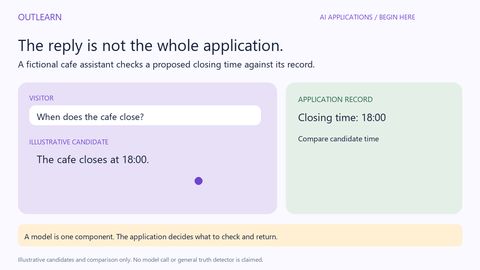
AI Application Foundations
58 lessons, 33 to 55 hours
 FreeWeb apps & analytics
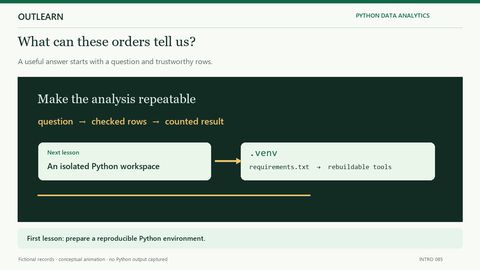
Python Data Analytics
66 lessons, 40 to 65 hours
Where this leads

This course is part of the AI Application Builder bundle: 3 courses for ₹799, against ₹1,097 bought one by one.
Frequently asked questions
Do I need a GPU or network access?
No. The project rebuilds from a supplied corpus and seed on a CPU-only laptop without network access.
What should I finish first?
AI Application Foundations and Python Data Analytics, or equivalent.
How is Embeddings & Semantic Search structured, and is it open now?
It has 8 modules and 50 lessons. It is not yet released to learners.
Be first in when Embeddings & Semantic Search opens
Email us and we will tell you as soon as enrolment opens.
Notify me when it opens