
- 58lessons
- 4guided projects
- 9module checkpoints
- 2.4hours of video
What you'll learn
- Decide which work belongs to a model, application code or a human reviewer.
- Check model output against a schema and the rules of the task.
- Set deadlines, retry limits and human approval points for tool actions.
- Measure field-level accuracy, common failures and cost per successful request against a fixed test set.
Skills you'll gain
- AI capabilities
- limits
- LLM concepts
- Prompt design
- Structured outputs
- Model API integration
- Tool
- workflow boundaries
- Evaluation
- failure
- Privacy
- costs
- Application project
Tools you'll use
- Python 3 standard library
- Local simulated model API
- JSON and JSON Lines fixtures
Details to know
- Certificate on completionIssued after your final project is reviewed
- 9 module checkpointsA quiz and a practical task close each module
- Self-pacedStudy any time; your progress is saved
- Intermediate levelSee what you need before you start, above
How every lesson works
Each lesson follows the same four steps, so you always know what comes next.
- 01
Watch & Learn
A short animated video explains one idea at a time.
- 02
Guided Practice
Work through an example step by step and check the result.
- 03
Quiz & Challenge
Short questions check the idea has landed before you move on.
- 04
Mini Project
Build something useful from a project brief.
Learn at your own pace
This is a self-paced course. There are no live classes and no fixed timetable.
- Start any timeStudy when it suits you. Lessons are short, so they fit around work or college.
- Pick up where you left offYour progress is saved to your account.
- Ask when you're stuckUse Ask Mentor inside the learning platform.
Your path in 3 phases
Each phase ends with something you have built and checked.
- 01
Modules 1 to 3
Define and test the AI task
Choose where a model belongs, plan around context limits, and compare versioned prompts against recorded cases.
You build: A task brief, versioned prompt and recorded responses to replay.
- 02
Modules 4 to 6
Integrate the model into a workflow
Parse and validate model replies, set API deadlines and retry limits, and require approval for actions with lasting effects.
You build: A validation workflow with a fallback, retry limit and approval boundary.
- 03
Modules 7 to 9
Evaluate and demonstrate the application
Score results on a fixed test set, redact sensitive data, measure cost per success and demonstrate the application’s failure handling.
You build: A repeatable evaluation, per-field results and a demonstration of one failure path.
Full curriculum
9 modules and 58 lessons, 33 to 55 hours of study
01AI capabilities and limits6 lessons, 3 to 4 hours
Lessons
- A model call is a sampled function, not a lookup
- Matching task shapes to what language models do well
- Spotting unsupported claims in model answers
- Knowledge cutoffs and information the model cannot have
- Choosing rules over a model when rules are enough
- A feasibility brief with risks and a human fallback
After this module you can
- Run the same recorded prompt through a replay client five times and explain why a live model call could not be asserted with a plain equality test.
- Sort ten feature requests into classification, extraction, transformation, generation, retrieval of facts, or exact computation, and mark which are a good fit.
- Produce a one-page feasibility brief for an AI feature that names the task, expected failure modes with severities, and the human fallback when the model fails.
02LLM concepts7 lessons, 3 to 5 hours
Lessons
- Tokens: why character and word counts mislead
- The context window as an input-plus-output budget
- Sampling settings: temperature and top-p on a toy distribution
- Messages, roles and why every request resends the history
- What changes model behaviour: prompt, context, retrieval, tools or training
- Hosted and open-weight local models: a comparison grounded in documented interfaces
- Trimming conversation history under a token budget
After this module you can
- Count tokens for sample strings with a supplied toy tokenizer and show that token counts differ from character and word counts for numbers, code and non-English text.
- Compute whether a prompt, a retrieved document and a reserved reply fit within a stated window and decide what to cut when they do not.
- Implement history trimming that keeps the system message and the newest turns within a token budget and compare it with a summarise-the-old-turns strategy on a recorded conversation.
03Prompt design6 lessons, 3 to 4 hours
Lessons
- Separating instructions, context and user input with delimiters
- Constraining format, length and tone, and checking the constraints in code
- Few-shot examples: selecting, ordering and avoiding leakage
- Decomposing a task into inspectable prompt steps
- Prompt templates as versioned, validated code
- A prompt regression table that catches behaviour changes between versions
After this module you can
- Build a prompt assembler that places instructions, reference context and untrusted input in clearly delimited sections and neutralises delimiter text inside the input.
- Write prompt constraints for length, required keywords and forbidden phrases, then implement a checker that verifies each constraint on recorded outputs.
- Run a fixed table of cases against recorded outputs for prompt v1 and v2, report which cases changed verdict, and decide whether v2 may replace v1.
04Structured outputs6 lessons, 3 to 4 hours
Lessons
- A JSON schema as the contract between model and program
- Parse first, then validate: separating syntax errors from schema errors
- Prompt-only JSON versus provider-enforced structured output
- Bounded repair loops: feeding validation errors back safely
- Refusals, truncation and incomplete output
- Semantic validation and typed objects after schema validation
After this module you can
- Write a schema with types, required fields, an enum and no extra properties for a record, and show which of eight sample outputs it accepts and rejects.
- Implement a two-stage checker that tries JSON parsing, strips documented wrapper noise such as code fences, and reports syntax and schema errors as different categories.
- Add semantic checks (line items sum to the total, dates plausible, category consistent with vendor) and convert validated data into a typed object, flagging schema-valid but wrong outputs.
05Model API integration7 lessons, 3 to 5 hours
Lessons
- Anatomy of a chat request and response over HTTP
- Secrets and configuration: keys never live in code or logs
- Classifying API errors: retry, fix or stop
- Exponential backoff with jitter and retry-after on a fake clock
- Client-side rate limiting with a token bucket
- Streaming replies: parsing server-sent events and mid-stream errors
- Timeouts, deadlines and a latency budget
After this module you can
- Send a JSON request with the headers and body fields a documented messages API expects to a loopback fake, and extract text, token usage and the request id from the reply.
- Load an API key from an environment variable, refuse to start without it and prove with a log-capture test that the key value never appears in logs or error messages.
- Enforce a per-attempt timeout and an overall deadline across retries on a fake clock, and attribute elapsed time to attempts, waits and time to first token.
06Tool and workflow boundaries6 lessons, 3 to 4 hours
Lessons
- Workflow or agent: choosing the simplest control structure
- Defining a tool: name, description and parameter schema
- The tool round trip: the model proposes, your code executes
- Validating and authorising tool arguments
- Loop limits: step caps, repeat detection and budgets
- Side effects, approval gates and idempotency
After this module you can
- Classify eight tasks as fixed workflow, workflow with a branch, or model-driven loop, and estimate the worst-case number of model calls for each choice.
- Write tool definitions with a precise name, a description stating when to use it and a JSON-schema input, and lint them against a rule list.
- Classify tools as read-only, reversible or irreversible, require human approval before irreversible actions and prevent duplicate execution with idempotency keys.
07Evaluation and failure6 lessons, 3 to 4 hours
Lessons
- A failure taxonomy: naming how LLM features fail
- Building a small golden set from requirements
- Field-level scoring of structured outputs
- Traces as evaluation hooks
- Graceful degradation: fallbacks when the model fails
- Small samples, uncertainty and a release decision
After this module you can
- Classify forty logged failures into a fixed taxonomy (malformed output, refusal, truncation, wrong value, ungrounded claim, policy violation, timeout, tool error) and rank classes by count and severity.
- Create a twenty-case golden set with inputs, expected fields and category tags that covers each requirement and each known failure class, and verify coverage with a script.
- Compute a Wilson confidence interval for a pass rate from a small golden-set run, compare two versions honestly and apply a pre-registered release rule.
08Privacy and costs7 lessons, 3 to 5 hours
Lessons
- Data classification and minimisation before any model call
- Redaction and pseudonymisation with a reversible mapping
- Prompt injection basics: direct and indirect, tested against a fake model
- Treating model output as untrusted input to the rest of the system
- Token cost arithmetic on a supplied price table
- Cost and latency controls: caps, caching, routing and budgets
- Logging, retention, consent and deletion
After this module you can
- Classify fields of a record as public, internal, personal or secret, apply a send/mask/drop policy per class and produce the minimal payload for a model call.
- Replace emails, phone-like numbers and card-like numbers in free text with stable placeholders, restore them in the model's reply and prove nothing sensitive reached the fake provider.
- Implement a retention schedule for traces and stored replies, honour a consent flag and process a deletion request across stores, with a test that verifies nothing remains.
09Application project7 lessons, 3 to 5 hours
Lessons
- Scoping the project: components, contracts and a done definition
- Assembling the core pipeline from the module components
- Wiring resilience and budgets into the pipeline
- Wiring safety controls: minimisation, redaction, injection tests and output handling
- Running the evaluation and writing a failure report
- Deployment concerns: configuration, versioning, health checks and rollback
- Responsible-AI review, limitations page and demonstration
After this module you can
- Write a one-page architecture with components, interface contracts, data flow, a budget and a measurable done definition for the receipt-and-policy assistant.
- Wire the prompt renderer, client, response router, validator and typed object into one function and pass an end-to-end test on recorded scenarios.
- Write a limitations and disclosure page, run a consistency spot-check across user groups on recorded outputs, document human oversight points and prepare a trainer-reviewed demonstration script.
What you'll build
4 guided projects along the way, then a final project.
Prompted, validated extraction
after module 4Resilient client with safe tools
after module 6Evaluation, privacy and cost evidence
after module 8The assembled application
after module 9
What guided project 1 looks like when it runs
You build the checking around a model, not the model. Ten receipts go through your pipeline: replies are parsed, checked against a schema and a few plain rules, and repaired at most twice before the receipt is rejected.
python run.py
receipt                                 verdict   repairs  reason
----------------------------------------------------------------------------------------------------
R1 clean reply                          accepted  0
R2 reply inside a code fence            accepted  0
R3 trailing comma, then fixed           accepted  1
R4 extra key, then fixed                accepted  1
R5 total wrong twice, then fixed        accepted  2
R6 total wrong three times              rejected  2        items differ from total by 0.50
R7 stopped at the output limit          rejected  2        reply stopped at the output limit
R8 date in the future                   rejected  2        date in the future
R9 provider refuses                     refused   0        provider declined
R10 receipt text closes the tag early   accepted  0
----------------------------------------------------------------------------------------------------
10 receipts: 6 accepted, 3 rejected, 1 refused. 20 calls to the fake provider, never more than 2 repairs for one receipt.
Final project
Build a receipt and policy assistant, a meeting-action assistant or a handbook question assistant using recorded model responses. Demonstrate how it handles bad output and explain the trade-offs in your evaluation.
What you submit
How it's reviewed
Try the first lesson
Catch a plausible but wrong model output
A model extracts an invoice into JSON. The fields and types meet the schema, but line items of ₹40 and ₹35 are reported with a total of ₹90.
Your turn. Decide what the application should do before using the extracted total.
{ "lineItems": [40, 35], "total": 90 }
Where you'll use it
- Check extracted invoice data before passing it to an operations workflow.
- Turn meeting notes into structured action items for someone to approve.
- Compare prompt changes against fixed examples before updating an internal assistant.
Roles that use these skills
- Application development
- AI integration
- Software quality assurance
Earn the certificate by building, not watching
- Complete the lessons and pass each module checkpoint.
- Build your final project and demonstrate it.
- OUTLEARN reviews your project and issues your certificate. It is not issued automatically.
Related courses
Take first
 FreeStart here
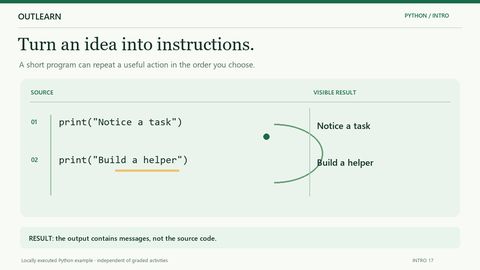
Python Programming
138 lessons, 57 to 97 hours
 FreeWeb apps & analytics
REST API Design
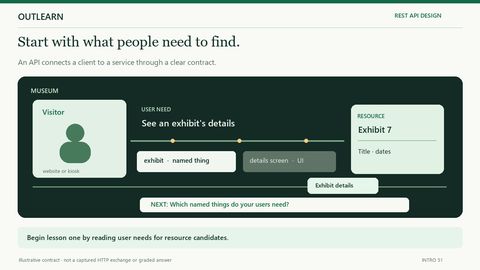
50 lessons, 27 to 47 hours
Where this leads
 ₹99Data, AI & infrastructure
Embeddings & Semantic Search
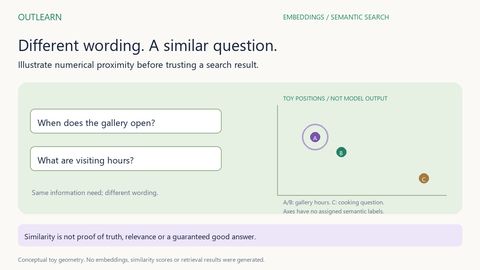
50 lessons, 26 to 43 hours
 ₹499Data, AI & infrastructure
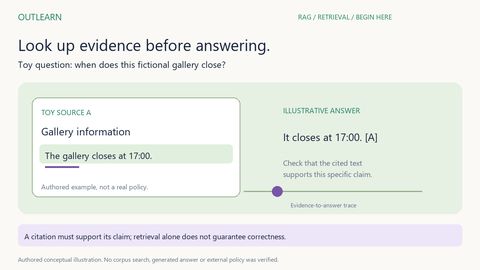
Retrieval-Augmented Generation
50 lessons, 28 to 48 hours
 ₹399Data, AI & infrastructure
LLM Evaluation & Testing
50 lessons, 30 to 51 hours
This course is part of the AI Application Builder bundle: 3 courses for ₹799, against ₹1,097 bought one by one.
Frequently asked questions
Which languages is this course in?
Every lesson has audio and captions in English, Hindi, Telugu, Tamil, Kannada and Malayalam. You can switch language inside any lesson.
How do I report a problem in a lesson?
Email [email protected] with the course and lesson name. We read every report and correct the lesson.
Start AI Application Foundations today
Every lesson has audio and captions in English, Hindi, Telugu, Tamil, Kannada and Malayalam.
Start learning