
- 40lessons
- 4guided projects
- 8module checkpoints
- 1.7hours of video
What you'll learn
- Read a model release's files, format and model card, check a licence against a use-case matrix, and pin a revision with verified digests.
- Trace a request through tokenisation, prefill and decode, predict sampling and context effects, and choose a serving stack using only fetched documentation facts.
- Write and test an OpenAI-style service contract, streaming assembly, field-support adapter, error and retry rules and alias-based rollback against a fake server.
- Compute latency percentiles, throughput sweeps, load-test validity and capacity counts from recorded traces.
- Deliver a start gate, cost model, rollout rules, runbook and a resource and quality report in which every claim cites an artifact.
Skills you'll gain
- Model formats
- licences
- Hardware
- memory
- Inference runtime
- Quantization trade-offs
- Serving contracts
- Performance measurement
- Access
- observability
- Deployment project
Tools you'll use
- Python
- OpenAI-style HTTP API contract
- llama.cpp (optional)
- Ollama (optional)
- Docker concepts
Details to know
- Certificate on completionIssued after your final project is reviewed
- 8 module checkpointsA quiz and a practical task close each module
- Self-pacedStudy any time; your progress is saved
How every lesson works
Each lesson follows the same four steps, so you always know what comes next.
- 01
Watch & Learn
A short animated video explains one idea at a time.
- 02
Guided Practice
Work through an example step by step and check the result.
- 03
Quiz & Challenge
Short questions check the idea has landed before you move on.
- 04
Mini Project
Build something useful from a project brief.
Learn at your own pace
This is a self-paced course. There are no live classes and no fixed timetable.
- Start any timeStudy when it suits you. Lessons are short, so they fit around work or college.
- Pick up where you left offYour progress is saved to your account.
- Ask when you're stuckUse Ask Mentor inside the learning platform.
Your path in 3 phases
Each phase ends with something you have built and checked.
- 01
Modules 1 to 3
Formats, hardware and runtimes
Read model files and licences, budget memory and speed from supplied tables, and trace a request through a runtime.
You build: Guided project: Model intake and memory budget sheet.
- 02
Modules 4 to 6
Quantisation, contracts and performance
Choose a quantised variant from recorded results, test an HTTP service contract against a fake server, and compute latency and throughput.
You build: Guided project: Runtime choice and quantised variant decision; Service contract and measured performance.
- 03
Modules 7 to 8
Security and the deployment project
Control access and usage, test injection and output handling, and assemble a start gate, cost model, rollout rules and runbook.
You build: Guided project: Secured and observable service.
Full curriculum
8 modules and 40 lessons, 25 to 44 hours of study
01Model formats and licences5 lessons, 2 to 4 hours
Lessons
- Reading a model release manifest: weights, config, tokenizer and what is missing
- Choosing between safetensors, pickle-based checkpoints and GGUF for a target runtime
- Extracting licence, base model and dataset facts from a model card's metadata block
- Checking a licence against a deployment use-case matrix with synthetic licence classes
- Pinning a model revision and verifying downloaded files with SHA-256
After this module you can
- Given a supplied release manifest, classify each file as weights, architecture config, tokenizer or documentation and list which files a runtime still lacks to load the model.
- Choose the weight file format a named runtime can load from a supplied compatibility table, and parse the header of a toy GGUF file to read its version, tensor count and metadata count.
- Write a lock file that records repository id, revision and per-file SHA-256 for a supplied toy release, and a verifier that reports matching, changed, missing and extra files.
02Hardware and memory5 lessons, 2 to 4 hours
Lessons
- Weight memory arithmetic: parameters times bits per weight
- KV-cache memory: layers, KV heads, head size, context length and sequences
- Why decode speed is bounded by memory bandwidth and how to estimate the ceiling
- A fit budget: weights, KV cache, runtime overhead and headroom against capacity
- Partial layer offload: splitting layers between fast and slow memory and estimating the speed
After this module you can
- Compute the bytes needed to hold a model's weights from a parameter count and a bits-per-weight figure, in decimal gigabytes and in GiB, and explain why the file on disk is slightly larger than the product.
- Compute KV-cache bytes from layers, KV heads, head dimension, context length, bytes per element and concurrent sequences, and predict how each factor scales the result.
- Given per-layer bytes, a fast-memory budget and two bandwidths, compute how many layers fit in fast memory and estimate seconds per token as the sum of bytes read from each memory divided by its bandwidth.
03Inference runtime5 lessons, 2 to 4 hours
Lessons
- Request lifecycle: tokenise, prefill, decode and stop on a timed trace
- Sampling settings on a toy distribution: temperature, top-p and seeds
- Context budgets and chat templates: prompt plus completion within the window
- Choosing a serving stack from fetched documentation facts: llama.cpp, Ollama and vLLM
- Validating a runtime configuration before launch with a rule-based script
After this module you can
- Split a recorded request trace into tokenisation, prefill and decode phases, compute time to first token and total time from prompt tokens, output tokens and two rates, and name the stop reason.
- Compute softmax probabilities for a small logit vector at a stated temperature, apply top-p truncation with renormalisation, and predict whether a fixed seed makes two runs identical.
- Write a validator that reads a flag set for a llama.cpp-style server and reports rule violations: context size over the model limit, parallel slots over the memory plan, exposed host without an API key, and missing metrics flag.
04Quantization trade-offs5 lessons, 2 to 4 hours
Lessons
- Symmetric integer quantisation by hand: scale, round, dequantise
- Block scales and effective bits per weight in a toy block format
- Rounding error metrics and the outlier effect on a block's scale
- A quality gate for a quantised variant using paired recorded results
- Choosing a variant from size, speed and quality with a Pareto filter
After this module you can
- Quantise a short float vector to a stated bit width with a max-abs scale, dequantise it, and report each element's rounding error and the number of representable levels.
- Compute effective bits per weight and file size for a toy block format (b-bit weights, a scale of s bits per block of n weights, optional offset), and compare formats at equal nominal bit width.
- Filter a supplied table of model variants by memory and quality constraints, remove dominated rows, and pick one with a written reason that cites table cells.
05Serving contracts5 lessons, 2 to 4 hours
Lessons
- A chat-completions contract test against a fake OpenAI-style server
- Assembling a streamed completion from server-sent chunks
- Field-support gaps between stacks and a client that fails loudly
- An error contract: status mapping, context overflow and retry rules
- Model aliases, version listing and pinning so rollback is one change
After this module you can
- Write a contract test that sends a chat request to a supplied fake server and checks status, content type and the course contract's required response fields, with each failed check named.
- Parse a recorded stream of data-prefixed JSON lines, tolerate lines split across reads, assemble the full text, and detect truncated streams missing the end marker.
- Design and test a serving contract in which clients use a stable alias, the server's model list maps aliases to pinned revisions, and each response reports the revision that served it; verify that a rollback is a one-line alias change.
06Performance measurement5 lessons, 2 to 4 hours
Lessons
- Latency metrics from timestamps: time to first token, inter-token latency and end-to-end
- Percentiles with nearest-rank and why the mean hides tail latency
- Batching and concurrency: total throughput against per-stream speed
- Judging a load test: warm-up, open versus closed loop and sample counts
- Capacity planning: instances needed from peak load, tokens per request and utilisation
After this module you can
- Compute time to first token, mean inter-token latency, decode rate and end-to-end latency from per-request timestamps in a supplied trace, and mark metrics undefined when a request produced fewer than two tokens.
- Compute p50, p95 and p99 by the nearest-rank rule on a sorted latency list, compare them with the mean, and state the smallest sample size at which each percentile is not just the maximum.
- Compute the instance count needed for a peak request rate from tokens per request, a measured per-instance throughput at the SLO operating point, a target utilisation and a redundancy rule, and show the sensitivity to each input.
07Access and observability5 lessons, 2 to 4 hours
Lessons
- Network exposure and API keys: who can reach the port
- Rate limits and bounded consumption: token buckets and request caps
- Prompt injection and output handling tested with recorded transcripts
- Reading metrics exposition text and turning counters into rates
- Alert rules on a metric series: thresholds, duration and false alarms
After this module you can
- Classify supplied launch configurations as local-only, exposed-with-key or exposed-without-key from the host, port and key settings, and fix the unsafe ones without placing a secret on a command line.
- Simulate a token-bucket limiter over a recorded arrival list, report accepted and rejected requests, and choose caps on body size and max_tokens that bound the worst-case cost of one request.
- Evaluate alert rules with a threshold and a for-duration over a supplied per-minute series, report when each would first fire and resolve, and tune a rule that flaps.
08Deployment project5 lessons, 2 to 4 hours
Lessons
- A start gate: verify digests, validate flags and wait for readiness
- Cost per million tokens from price, throughput and utilisation
- Canary rollout and rollback decided by rules fixed in advance
- A runbook tested against recorded incidents: symptom to cause to action
- The resource and quality report: every claim tied to an artifact
After this module you can
- Write a start script that runs, in order, the digest verifier, the configuration validator and a readiness poll against a fake server that returns 503 while loading and 200 when ready, and exits non-zero with a named reason at the first failing step.
- Compute cost per million generated tokens from an hourly price, a throughput measured at the SLO point and a utilisation, compare a self-hosted estimate with a supplied per-token price, and find the break-even monthly volume.
- Assemble the final report from the project's artifacts and run a checker that fails any claim lacking an artifact id, a number outside the artifact's value, or a missing limitation; optionally run a small live model for an ungraded smoke check.
What you'll build
4 guided projects along the way, then a final project.
Model intake and memory budget sheet
after module 2Runtime choice and quantised variant decision
after module 4Service contract and measured performance
after module 6Secured and observable service
after module 7
Final project
Local open-model inference service with resource and quality measurements.
What you submit
Source and artifact submission: scripts, tables, lock file, report and checker output in one folder with a setup README.
How it's reviewed
Trainer-reviewed demonstration including replay of two recorded incidents through the runbook. Marked against the course project review rubric.
Where you'll use it
- Check whether a model fits a machine's memory and meets a latency target before buying or deploying.
- Roll out a new model alias behind a canary and roll back on recorded results.
Roles that use these skills
- Machine learning engineer
- MLOps engineer
- Platform engineer
Earn the certificate by building, not watching
- Complete the lessons and pass each module checkpoint.
- Build your final project and demonstrate it.
- OUTLEARN reviews your project and issues your certificate. It is not issued automatically.
Frequently asked questions
Do I need to run a real model?
No. The graded project is built from supplied recordings. A live run with llama.cpp or Ollama is an optional, ungraded option.
What should I finish first?
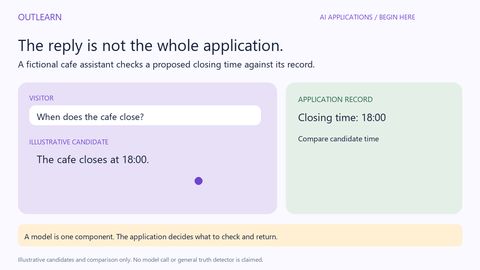
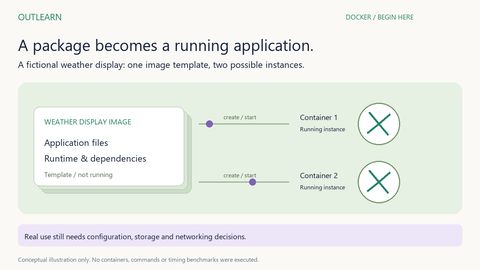
AI Application Foundations and Docker Fundamentals.
How is Open-Source LLM Deployment structured, and is it open now?
It has 8 modules and 40 lessons. It is not yet released to learners.
Be first in when Open-Source LLM Deployment opens
Email us and we will tell you as soon as enrolment opens.
Notify me when it opens